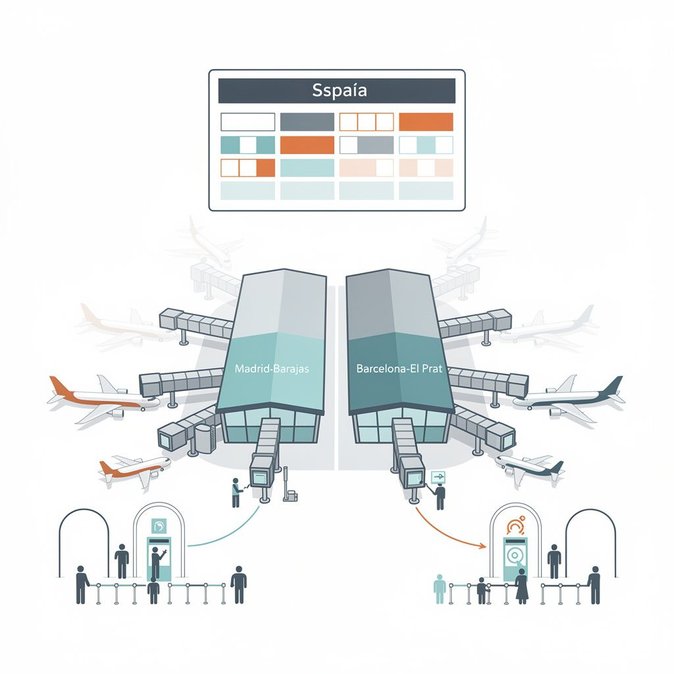
Spanish airport operator Aena announced on 3 July 2026 that it will, for the first time, publish terminal-specific capacity limits for Adolfo Suárez Madrid-Barajas and Josep Tarradellas Barcelona-El Prat as part of its DORA III investment cycle (2027-31). The measure responds to chronic congestion at immigration and security during morning and late-afternoon peaks and aims to ensure service quality ahead of the full roll-out of the EU’s biometric Entry/Exit System.
For travelers and corporate mobility planners who want to stay ahead of the paperwork curve created by these operational changes, VisaHQ can help streamline the process of securing Schengen visas, passport renewals, and any future EES-related documentation. Its online platform offers step-by-step guidance and live support, reducing the risk of last-minute surprises at immigration checkpoints; learn more at
Under the plan, each terminal will have a declared hourly passenger ceiling. Airlines seeking additional slots for summer 2027 will have to demonstrate that their schedules fit within those ceilings or shift operations to off-peak times. Historic slots remain protected, but carriers hoping to grow—especially low-cost bases at Terminal 1 (Madrid) and Terminal 2 (Barcelona)—may need to reroute or up-gauge aircraft. For corporate travel managers, the near-term impact is limited, yet longer-term itinerary planning could be affected as early-morning Madrid-to-Europe frequencies may be capped. Freight forwarders using belly-hold capacity should also watch for constraints on late-night wide-body arrivals. Aena insists the limits will ease once terminal expansion projects are completed, but construction is slated to run through 2031. The announcement comes amid industry pressure to delay or soften the EES rollout because of fears of three-hour immigration queues this summer. By linking slot allocation to terminal capacity, Aena is effectively putting a hard ceiling on passenger numbers until biometric gates and staffing keep pace. Airlines have until September to comment before figures are sent to the Directorate-General of Civil Aviation for final approval.
For travelers and corporate mobility planners who want to stay ahead of the paperwork curve created by these operational changes, VisaHQ can help streamline the process of securing Schengen visas, passport renewals, and any future EES-related documentation. Its online platform offers step-by-step guidance and live support, reducing the risk of last-minute surprises at immigration checkpoints; learn more at
Under the plan, each terminal will have a declared hourly passenger ceiling. Airlines seeking additional slots for summer 2027 will have to demonstrate that their schedules fit within those ceilings or shift operations to off-peak times. Historic slots remain protected, but carriers hoping to grow—especially low-cost bases at Terminal 1 (Madrid) and Terminal 2 (Barcelona)—may need to reroute or up-gauge aircraft. For corporate travel managers, the near-term impact is limited, yet longer-term itinerary planning could be affected as early-morning Madrid-to-Europe frequencies may be capped. Freight forwarders using belly-hold capacity should also watch for constraints on late-night wide-body arrivals. Aena insists the limits will ease once terminal expansion projects are completed, but construction is slated to run through 2031. The announcement comes amid industry pressure to delay or soften the EES rollout because of fears of three-hour immigration queues this summer. By linking slot allocation to terminal capacity, Aena is effectively putting a hard ceiling on passenger numbers until biometric gates and staffing keep pace. Airlines have until September to comment before figures are sent to the Directorate-General of Civil Aviation for final approval.