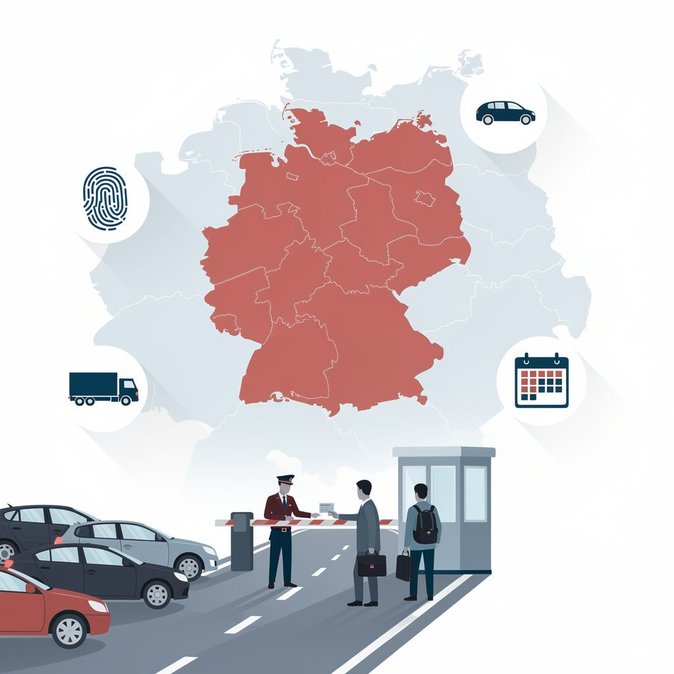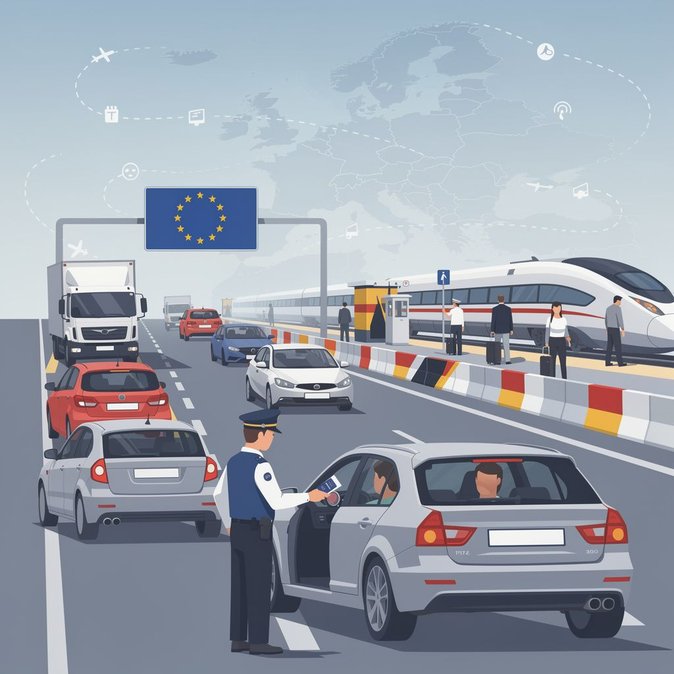
Germany’s Federal Ministry of the Interior has formally notified Brussels that the temporary border controls introduced at all German land frontiers will be prolonged for a further six-month period, from 16 September 2026 until 15 March 2027. The continuation was published on the European Commission’s Schengen website on 14 September and cites “continued serious threats to public security and order posed by high levels of irregular migration and migrant-smuggling as well as strain on reception capacity” as justification. Although systematic checks are normally forbidden inside the passport-free Schengen zone, Article 25 of the Schengen Borders Code allows a Member State to re-introduce controls for renewable six-month blocks if it can demonstrate an acute security risk. Germany first reinstated controls on its southern border with Austria during the 2015 refugee crisis and has since incrementally expanded them to all nine neighbouring countries, adding routes to Poland, Czechia and Switzerland in 2024 and to France, the Netherlands, Belgium, Denmark and Luxembourg in 2025. The latest extension means that, for the first time, every German land border will have been under some form of control for a continuous 30-month stretch. For business travellers and cross-border commuters the decision translates into sporadic passport inspections, vehicle spot-checks and longer waiting times at major motorway crossings such as Walserberg (A8, Austria), Frankfurt/ Oder (A12, Poland) and Breitenau (A17, Czechia). Rail passengers on EuroCity and ICE services can expect on-train checks by the Bundespolizei, while air travellers arriving from Schengen airports may again encounter documentation verification at the gate before baggage reclaim. Corporate mobility managers should advise staff to carry a valid passport or national ID card at all times—even when travelling only a few kilometres across the internal EU frontier—and to budget extra connection time on congested corridors. Companies relocating talent to Germany should anticipate possible delays in the physical arrival of new hires coming overland through neighbouring states. Logistics providers likewise face an operational impact: while freight is not directly targeted, spot-checks of HGVs often create tailbacks that ripple through supply chains. Politically, the extension will revive the debate on the future of Schengen. The European Commission repeatedly stresses that internal controls must remain “a measure of last resort” and has asked Berlin to present an exit strategy. However, with asylum figures still hovering around 180,000 applications a year and federal elections due in 2027, few observers expect Germany to lift the controls before spring next year at the earliest.