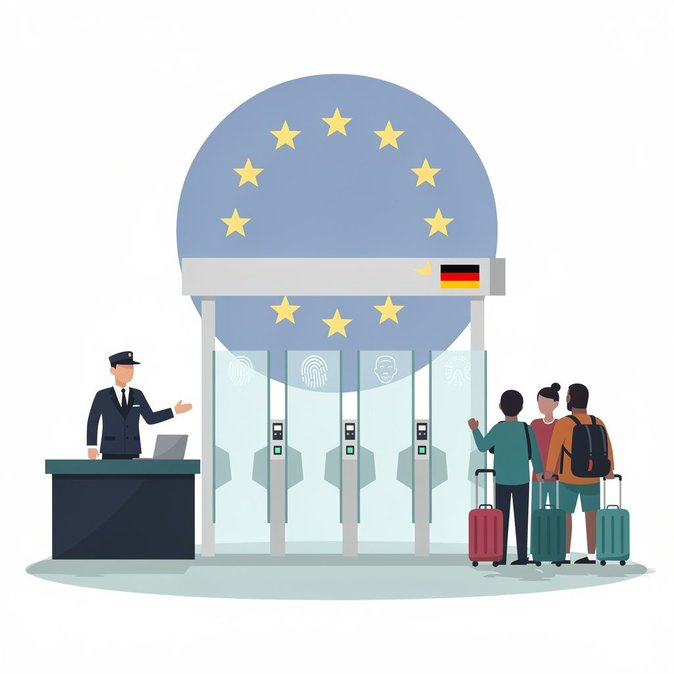
Germany has quietly pressed the pause button on the European Union’s new biometric Entry/Exit System (EES) only six months before it was meant to become mandatory at all external Schengen borders. In a joint move announced on 14 September 2026, Berlin sided with France, Italy, the Netherlands, Belgium, Greece, Malta, Portugal and Switzerland in suspending the scheme after trial operations triggered hours-long queues at major hubs such as Frankfurt, Paris-CDG and Amsterdam-Schiphol. EES is designed to replace the physical stamping of passports for travellers from outside the Schengen Area by capturing a facial image and four fingerprints on first entry. While the system worked smoothly at low-volume border crossings, airlines and airport operators warned that the additional thirty seconds per passenger would paralyse peak-hour traffic unless every kiosk, e-gate and border booth was fully staffed and the software interface stabilised. In late August Frankfurt Airport reported that a single A380 arrival with 480 non-EU passengers took 2 hours and 10 minutes to clear because half of the self-service kiosks repeatedly crashed. Under the compromise brokered by the Spanish EU Council Presidency, the nine countries will keep EES hardware switched on but revert to manual stamping until a new stress-test is completed in January 2027. For business travellers the immediate impact is positive: queuing times should fall back to pre-pilot levels and the risk of missed connections is reduced. Companies are nevertheless advised to keep contingency buffers because Germany has not set a new go-live date and could reactivate EES with only a few weeks’ notice if the technical issues are solved earlier than expected. Longer term, mobility managers should prepare employees for a fully biometric border: repeated fingerprint scans will become the norm and overstays will be calculated automatically. Travellers who rely on multiple-entry Schengen visas or the 90/180-day visa-free regime should expect more exact enforcement once EES finally enters service. At the same time, carriers anticipate savings because the system will eventually allow true ‘walk-through’ e-gates similar to those already used for EU nationals. The German Federal Police (Bundespolizei) emphasised that the suspension does not affect the EU’s separate ETIAS electronic travel authorisation, still scheduled to launch in October 2027. They also reminded employers that the existing 90/180-day rule continues to apply even while passport stamping remains manual.
Source: Haber Global