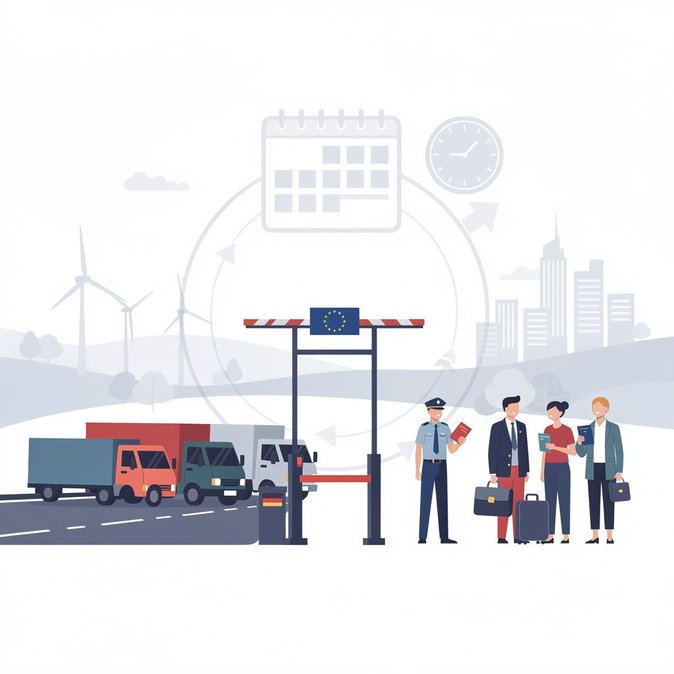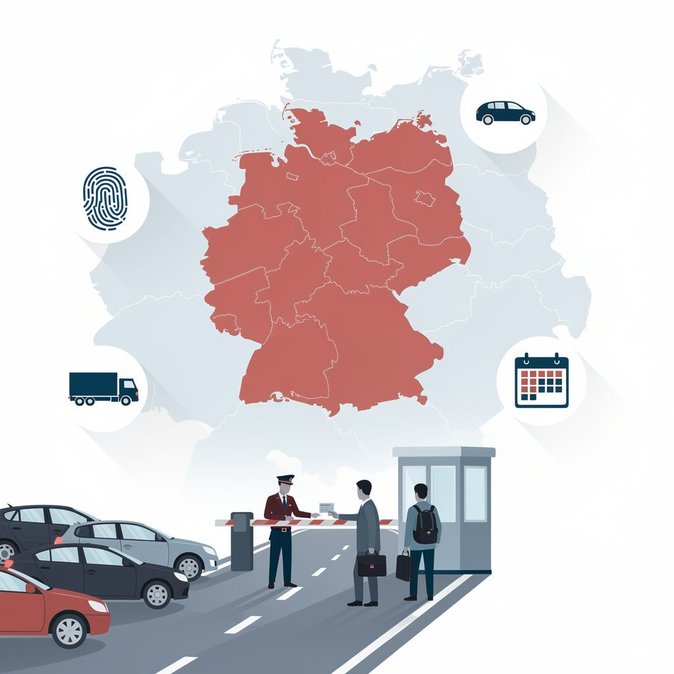
In a late-night notification to the European Commission on 15 September, the German Interior Ministry confirmed that it will temporarily re-introduce border controls at all of the country’s internal Schengen land crossings for a six-month period running from 16 September 2026 to 15 March 2027. According to the notice published on the Commission’s ‘Temporary Reintroduction of Border Control’ portal, Berlin cited “continued serious threats to public security and order posed by high levels of irregular migration and migrant smuggling” as well as the strain on reception facilities as the legal basis for the move. The controls will apply at Germany’s land borders with France, Luxembourg, Belgium, the Netherlands, Denmark, Austria, Switzerland, the Czech Republic and Poland. Air and sea borders remain unaffected for the time being. This is the fifth time since the 2015 refugee crisis that Germany has resorted to the exceptional measure laid down in Articles 25–29 of the Schengen Borders Code. What is new, however, is the breadth of the measure: whereas previous reintroductions focused mainly on the Austrian and Polish frontiers, the current notification explicitly covers *all* land boundaries. The Interior Ministry argues that organised smuggling networks have diversified their routes and that secondary movements of asylum seekers within Schengen now affect every neighbouring state. Germany registered more than 210,000 irregular entries in the first eight months of 2026 – already surpassing the total for 2025. For corporate travellers, assignees and cross-border commuters the most immediate impact will be the need to carry a passport or national ID card and to factor additional time for spot checks. Employers who routinely send staff by car, coach or rail across the borders into Germany should update their travel policies and prepare template letters proving the business purpose of the trip. Logistics providers are warning of possible delays for high-value shipments that rely on just-in-time delivery schedules, especially on the busy Rhine-Ruhr – Benelux corridor. German customs (Zoll) and the Federal Police plan to deploy mobile control teams that can be repositioned quickly in response to traffic flows. The Interior Ministry emphasises that the measure is proportionate and will be reviewed every two months. Past experience suggests that controls quickly become more selective once risk profiles have been established, but the political signal is unmistakable: the coalition government wants to show it is tightening the external and now also the *internal* Schengen border to buy time for an overhaul of the asylum system. Businesses should monitor the bi-monthly Commission assessments as the continuation or early termination of controls will hinge on those reports.