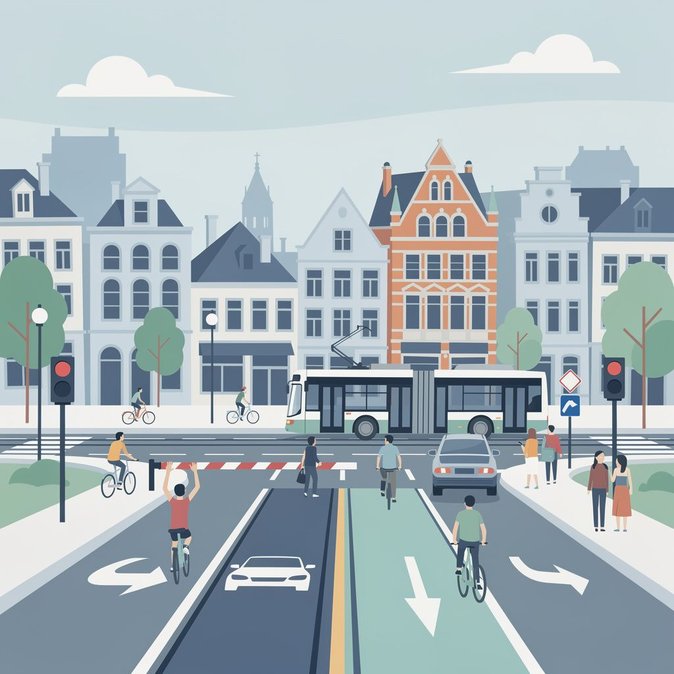
From 09:30 to 19:00 on Sunday, 20 September, the entire Brussels-Capital Region is closed to private motor vehicles for the annual Car-Free Sunday (Dimanche sans voiture / Autoloze Zondag). Organised under the umbrella of European Mobility Week, the initiative temporarily converts 160 km² of urban area into Europe’s largest low-traffic zone. Only emergency vehicles, taxis, diplomats and holders of a pre-approved pass may circulate, and the speed limit is capped at 30 km/h. For residents, the day is a celebration: museums spill onto pavements, pop-up cycle lanes appear on the inner ring road and street-food markets occupy normally congested avenues. For mobility managers and logistics providers, however, the event demands meticulous planning. Hotel shuttles, corporate car services and removal vans are barred, forcing companies to switch clients and assignees onto public transport. STIB-MIVB, De Lijn and TEC are running free services at enhanced frequencies, while Brussels Airport has doubled the capacity of bus 12 to Zaventem. Rail operator SNCB expects a 15 % spike in leisure ridership and has added extra coaches on S-trains from Antwerp and Ghent. Ride-share platforms have geofenced pick-up zones outside the region’s perimeter, and several multinational employers in the city’s EU quarter have issued ‘work-from-home’ guidance for staff rostered on Sunday shifts. The Brussels Government says the exercise cuts CO₂ emissions by roughly 60 t in a single day and, more importantly, encourages commuters to experiment with multimodal options. Surveys from previous editions show a 7 % permanent modal shift among participants. Employers with sustainability targets therefore see the day as an opportunity to promote green commuting schemes and test teleworking infrastructure. Nevertheless, business-travel advisers caution that visitors arriving by car from neighbouring countries could be caught unaware at border exits. GPS applications often fail to incorporate the one-day restriction, and rental-car firms have been asked to brief customers explicitly. Roadblocks on the inner ring will reopen gradually after 19:00, but traffic is typically heavier than normal until late evening.
Source: City of Brussels