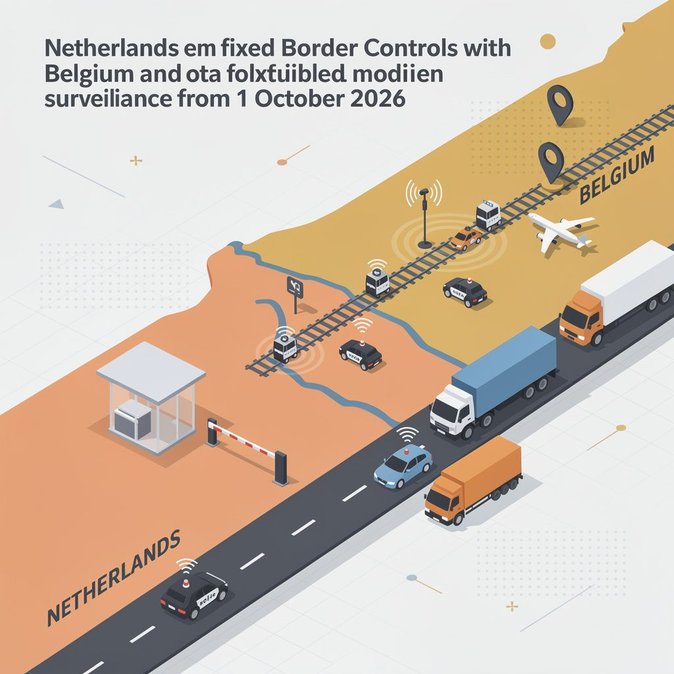
The Dutch cabinet has confirmed that, from 1 October 2026, the Royal Netherlands Marechaussee will switch from fixed border posts to an expanded Mobile Security Surveillance (Mobiel Toezicht Veiligheid – MTV) regime along its borders with Belgium and Germany. The announcement ends the temporary Schengen-internal border controls that were introduced in late 2024. Under the new legal framework, MTV teams can operate deeper inside Dutch territory and may inspect a higher percentage of flights, trains, and road traffic originating in Belgium. The daily ceiling on road and waterways checks has been raised, and aviation inspections will now be tied to passenger-volume percentages rather than absolute numbers—allowing controls to scale up during peak travel periods. For Belgian commuters and logistics operators this means spot-checks will continue, but locations and timings will be less predictable. The Dutch government says the shift will hit people-smuggling networks by making routes harder to plan, while ordinary cross-border traffic should suffer minimal disruption because checks are intelligence-led. Businesses that run shuttle buses or company cars across the border—particularly in the Eindhoven–Antwerp and Maastricht–Liège corridors—should brief drivers on possible stops and ensure travel documents are on board. Air passengers on the busy Brussels Airlines Brussels–Amsterdam codeshare may also encounter random ID inspections on arrival in the Netherlands. Belgium’s Interior Ministry said it understands the Dutch decision and will monitor any knock-on effects on traffic flows. No reciprocal tightening is planned on the Belgian side, but authorities urge travellers to carry proof of residence or employment to avoid delays.
Source: Rijksoverheid