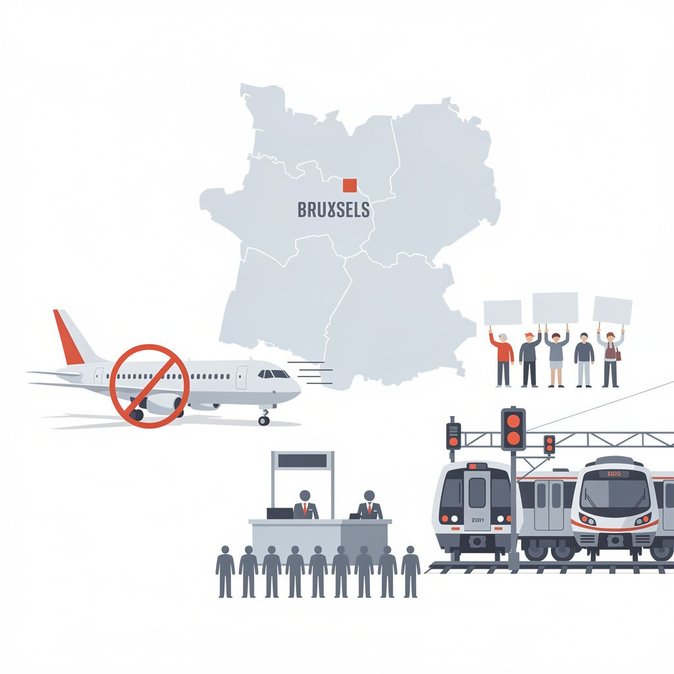
Belgium awakened on 25 September 2026 to a co-ordinated national strike called by the three main union federations, paralysing large parts of the country’s transport and public-service infrastructure. Air-traffic controllers at Brussels Airport and Brussels South Charleroi walked out from 05:00, forcing the cancellation of all departing flights and roughly half of arriving services. Trade-union officials estimate 48,000 passengers were directly affected. Rail operator SNCB maintained a skeleton timetable, but Eurostar and Thalys warned of overcrowding and potential delays as only two of Brussels’ four metro lines operated. Road traffic around the capital was snarled after small fires and ad-hoc barricades blocked sections of the inner ring. Police urged motorists to avoid Boulevard Roi Albert II and adjoining arteries; ride-share wait times peaked at over 40 minutes during the morning rush. Beyond transport, the action closed many municipal offices—including immigration desks where non-EU residents register their arrival—and forced courts to postpone trials because prison officers also joined the walk-out. HR managers with time-sensitive permit renewals should expect backlog once services resume on Monday. From a business-continuity angle, the strike hit manufacturing hardest; technology federation Agoria reported a 22 % production loss for the day. Logistics companies diverted time-critical consignments to Antwerp and Ostend airports, illustrating the value of multi-gateway strategies for inbound freight and assignment shipments. Union leaders warned of further demonstrations in October if wage-indexation and pension-reform talks fail. Multinationals should therefore keep crisis-management protocols on standby and review flexible-working policies that allow staff and assignees to operate remotely when transport networks shut down.
Source: The Brussels Times