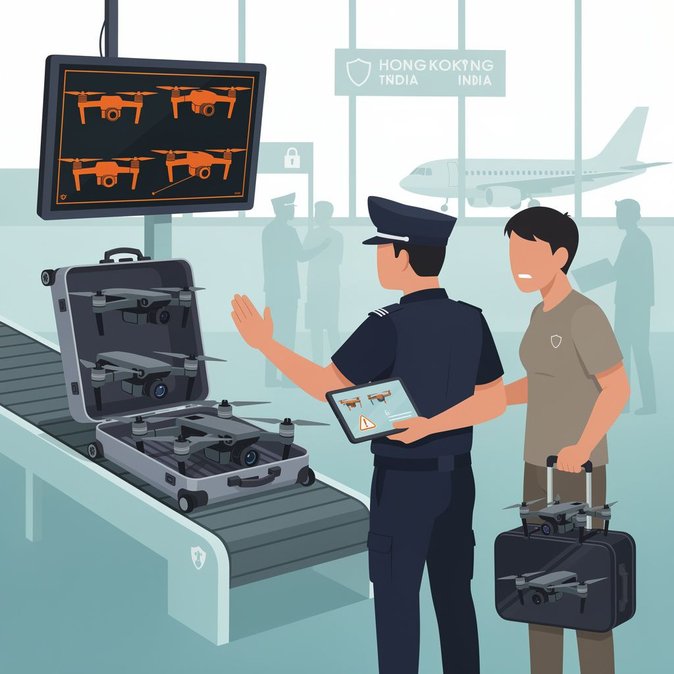
India’s border-control authorities intercepted a major high-tech smuggling attempt on 29 September when customs officers at Delhi’s Indira Gandhi International Airport recovered ten military-specification drones worth more than ₹1.03 crore. Acting on advance intelligence, officers stopped three Indian passengers who had flown in from Hong Kong via Vietnam and were attempting to walk through the green channel. A detailed baggage search uncovered ten Autel Robotics MDX-1 unmanned aerial vehicles equipped with thermal-imaging cameras and laser range-finders—features that classify them as defence-grade equipment requiring import clearance from India’s Directorate General of Civil Aviation (DGCA) and the Ministry of Defence. All accessories, including controllers and gimbals, were seized. The passengers were detained under the Customs Act 1962, and investigators are now probing possible end-users and whether the shipment is linked to unlicensed surveillance or cross-border insurgent groups. India strictly regulates the import of drones above 250 g and bans civilian possession of platforms capable of dropping payloads or carrying advanced sensors without explicit authorisation. For corporate mobility and supply-chain managers, the case is a reminder that high-value electronics—particularly dual-use items—face rigorous scrutiny at Indian ports of entry. Firms moving specialised equipment for mapping, inspection or cinematography projects should secure DGCA import permissions in advance and route cargo through freight channels rather than passenger baggage to avoid seizure. The incident follows a July directive that all drone imports, including prototypes for R&D, must be channelled through the single-window Digital Sky platform. Compliance failures risk confiscation, penalties and project delays—costs far exceeding any short-term savings from hand-carrying devices.
Source: The Economic Times