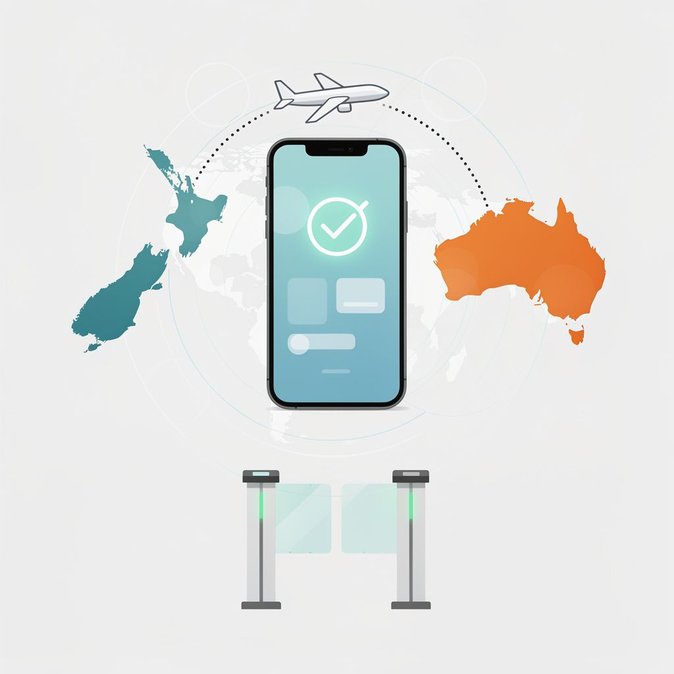
Crossing the ditch could become as simple as scanning a QR code. New Zealand’s governing National Party has announced that, if re-elected on 7 November, it will pilot paperless, passport-free travel between Australia and New Zealand from late 2028—timed to coincide with the two nations’ co-hosting of the ICC Men’s T20 World Cup. The proposal, revealed on 8 October, would allow travellers to upload verified credentials (passport, driver’s licence or national ID) to a smartphone app before departure. On arrival in Auckland, Wellington, Christchurch or Queenstown, passengers whose details have been pre-cleared by immigration, customs and biosecurity agencies would walk straight through e-Gates, stopping only if random baggage inspection is required. The scheme builds on Australia’s multi-year trial of digital incoming-passenger cards with Qantas and mirrors Singapore’s “end-to-end” biometric clearance. Trans-Tasman routes are among the world’s busiest: New Zealand welcomed 1.59 million Australians in the year to July 2026, while 1.42 million Kiwis flew the other way. Industry bodies on both sides argue that shaving even a few minutes off border formalities would lift airport throughput, reduce staffing costs and make same-day business trips more viable. Digital-privacy advocates want strict limits on data retention and sharing, and Australia’s Department of Home Affairs says any bilateral arrangement must meet its new Digital Passenger Card security architecture. Airlines will also seek clarity on liability if a traveller’s digital identity is later disputed. Still, travel-tech suppliers are already pitching solutions that could be scaled to other “trusted” corridors, including Singapore and the Pacific Islands. If Canberra signs on, the pilot would be the most significant change to Australasian border processes since SmartGate kiosks were introduced in 2007—potentially setting a benchmark for frictionless mobility among close economic partners.
Source: Time Out Australia