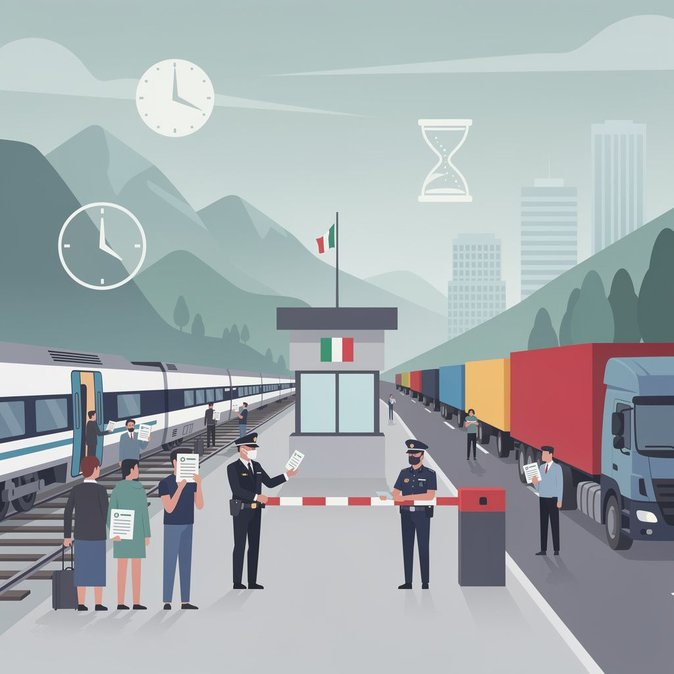
Ten people were arrested at the Frejus rail and road crossings in Bardonecchia over the past 11 days, the Turin border-police command reported on 11 October 2026. The detainees—seven on forged-document charges and three for outstanding European arrest warrants—were intercepted during spot checks introduced after Rome broadened its internal-border controls in response to the migrant surge in Spain’s Ceuta enclave. Although the Bardonecchia sector is 750 km from Ceuta, Interior-ministerial directives issued on 1 October require northern frontier posts to apply “intensified, risk-based verification” of passengers arriving from France—particularly on night trains used by secondary-movement migrants. Police sources told ANSA that officers now board every Paris–Milan TGV on the Italian side, inspecting identity papers and validating biometric data in the VIS and Eurodac systems; the operation adds around 20 minutes to travel time. For cross-border commuters and freight operators, the stepped-up regime means longer queues at the Frejus tunnel and tighter deadlines for CMR carnet checks. The local Confindustria chapter said several Piedmont manufacturers have moved urgent just-in-time deliveries to air freight “at material extra cost” to avoid missing supply-chain windows. SNCF Voyageurs and Trenitalia are advising corporate clients to book flexible fares through at least 16 October, when the current Schengen-suspension period is due to expire. Law firms warn that employees who routinely cross the border should carry full proof of assignment (letter of posting, A1 certificate, work-permit copy) to minimise delay. Under EU Regulation 883/2004, failure to present social-security documentation can lead to on-the-spot administrative fines, which several transport companies have already incurred this month. While the interior ministry insists the measure is temporary, observers note that similar “exceptional” controls on the Slovenian border have been rolled over repeatedly since 2019. Businesses with Franco-Italian mobility programmes should prepare for a possible extension and embed lead-time cushions into travel policies.
Source: ANSA