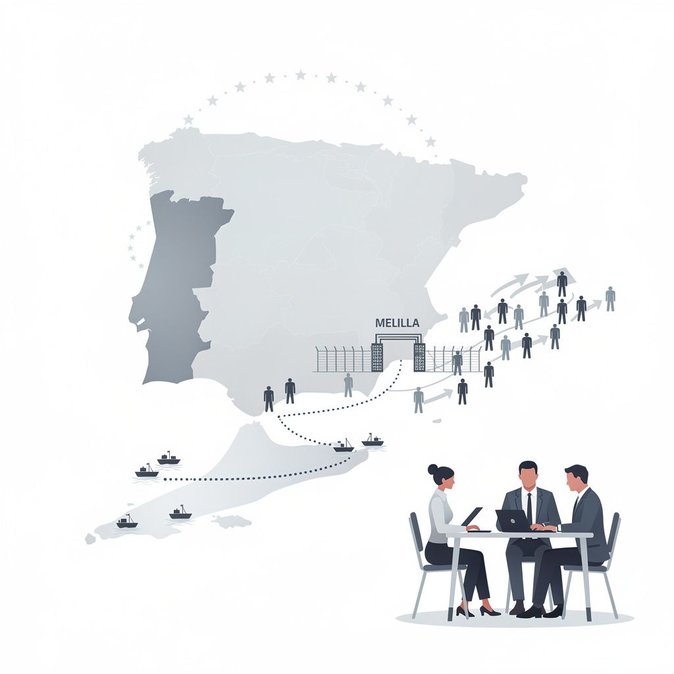
Spain and Italy have reached a political agreement to dismantle the extraordinary border controls that both countries re-introduced in mid-September, putting an end to a five-week suspension of normal Schengen rules for travellers moving between the two nations. The controls—carried out at Spanish ports and airports for passengers arriving from Italy and mirrored by Italian checks on arrivals from Spain—were triggered by Rome’s unilateral response to July’s mass border crossing in Spain’s North-African enclave of Ceuta. Under the deal, announced on the sidelines of the 16-17 October European Council in Brussels, Prime Minister Pedro Sánchez and Italian premier Giorgia Meloni instructed their interior ministers to produce a joint roadmap “within days” for the complete withdrawal of systematic checks. In practice, Italy will extend its current measures for seven additional days so that both countries can lift restrictions simultaneously, ensuring airlines, ferry operators and airport authorities can recalibrate security procedures at the same time. The move relieves airlines such as Iberia, Vueling and ITA Airways, which have had to introduce manual passport inspections and advance passenger screening for intra-EU flights—operations that added up to 25 minutes to turn-around times and generated crew-scheduling headaches for corporate shuttles between Madrid, Barcelona, Milan and Rome. Business-travel groups estimate that the controls added €6-€9 in direct cost per passenger for large multinationals using fast-track immigration channels. Spanish officials emphasise that the extraordinary checks were always meant to be temporary and that Madrid remains opposed to a wider trend of “quasi-permanent” Schengen derogations now maintained by Germany, Austria and France. For companies managing frequent cross-border assignments, the end of the controls restores the predictable ‘show-up-and-go’ model on the busy Spain-Italy corridor and removes the risk that employees could be asked for proof of accommodation funds or work authorisations at the gate. In the medium term, both governments will examine less intrusive alternatives such as joint risk-profiling teams and mobile biometric units—solutions that Brussels is promoting as part of the Digital Schengen Package due to enter into force in April 2027. For now, mobility managers can plan for a return to normal Schengen travel between the two Mediterranean economies from the week of 23 October 2026, subject to formal publication of the revocation orders in Spain’s BOE and Italy’s Gazzetta Ufficiale.
Source: El País
How VisaHQ can help
VisaHQ simplifies the visa application process for individuals and businesses. Check current travel requirements, prepare the required documents and manage your application online through the VisaHQ Spain portal.More From Spain
View all
Spain and Italy Agree to Lift Temporary Schengen Border Checks Imposed After Ceuta Migratory Crisis

Three Separate Airport Strikes Continue to Hit Spain on 16 October—Barcelona Groundforce Walk-Out Enters Third Month