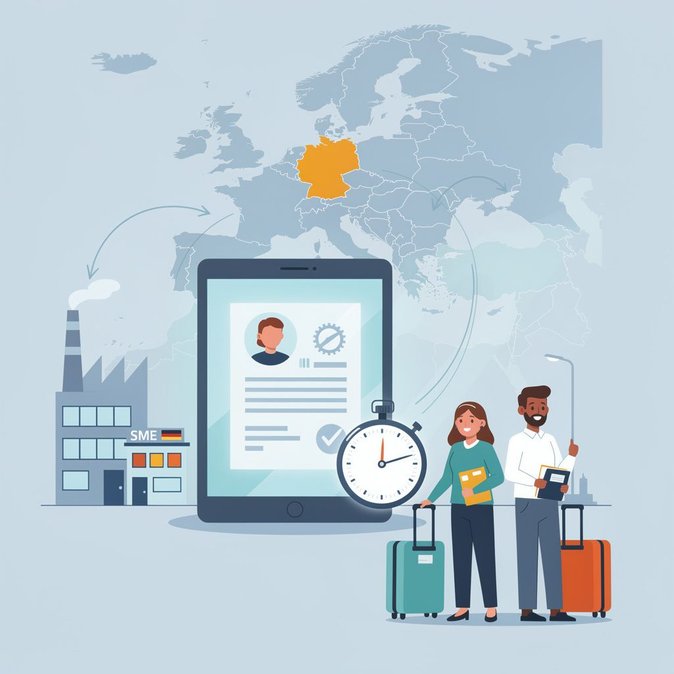
Germany’s chronic skills shortage will take centre stage in the Bundestag on 4 November, after the Green Party formally tabled two motions on 19 October aimed at turning the country into what MPs call a “magnet for international talent.” The first motion proposes a fully digital “Fachkräfte-Schnellvisum” (fast-track skilled-worker visa) with a statutory processing deadline of six weeks, English-language forms across all federal and state portals, and a bundled procedure that synchronises visa issuance, recognition of foreign qualifications and family-reunification permits. If adopted, the fast-track would build on July’s Skilled Immigration Act reform, but go further by obliging foreign missions to accept complete e-files and conduct remote interviews where biometrics infrastructure allows. Employers in engineering, IT and healthcare – sectors where vacancy ratios exceed 10 % – have long lobbied for such a channel, arguing that missing one product cycle can cost millions. In practice, the proposal could slash time-to-desk for Indian software engineers or Filipino nurses from today’s average of 4-5 months to fewer than 60 days. The second motion pushes back against a government plan to halve the annual quota of the popular West Balkan Regulation – a pathway that currently allows 50,000 citizens of Albania, Bosnia-Herzegovina, Kosovo, Montenegro, North Macedonia and Serbia to take up almost any job in Germany. Greens argue that the cap should stay because the rule has become a lifeline for small construction firms and hospitality businesses outside the major metros, where EU Blue Card holders rarely settle. While the governing coalition has not signalled immediate support, insiders say parts of the liberal FDP and all of the opposition CDU/CSU favour the digitalisation plank. Even partial passage would force the Foreign Office and Federal Employment Agency to accelerate long-planned IT upgrades to the Visa Information System and the fast-growing Recognition Portal. Companies should therefore track parliamentary deliberations and be ready to adapt global-mobility policies, especially around lead-time planning and relocation assistance.
Source: Deutscher Bundestag