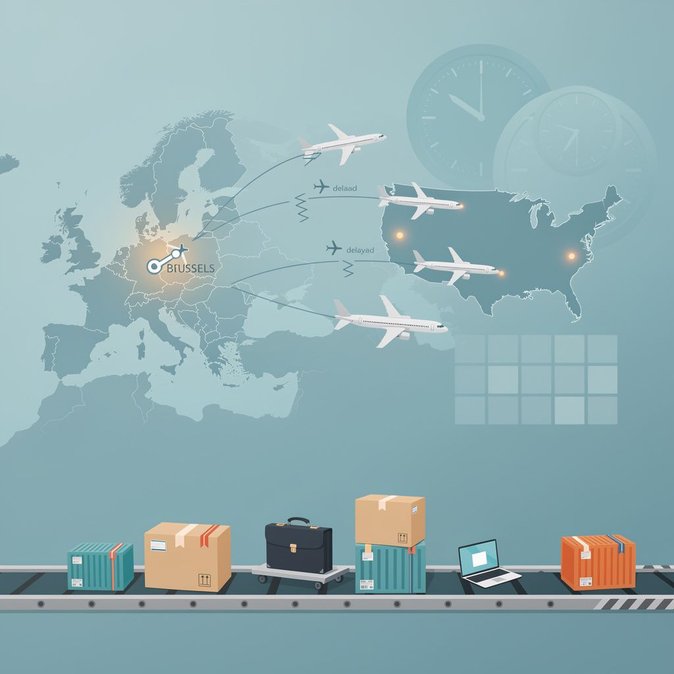
Belgian business travellers bound for the United States woke up on Saturday, 14 November, to discover that their flights had not left the ground. Between 23:00 on Friday night and 06:00 on Saturday morning (CET), EUROCONTROL ordered all US-bound departures across its network – including passenger services from Brussels Airport (BRU) and cargo flights from Liège (LGG) – to remain on stand-by. The unprecedented request was made after the US Federal Aviation Administration (FAA) suffered a nationwide communications outage that prevented American air-traffic controllers from receiving digital flight plans. The immediate impact in Belgium was limited in scale but high in concentration. Brussels Airport’s early-morning long-haul bank normally includes United Airlines’ Brussels–Chicago service and Brussels Airlines’ daily New York departure, while Liège is home to a cluster of overnight freighters serving New York and Cincinnati. Challenge Airlines BE flight FRH591 to JFK, scheduled for 05:15, fell squarely inside the embargo window, although the carrier has yet to confirm whether the aircraft eventually operated. EUROCONTROL’s decision highlights how closely interconnected global air-traffic systems have become. Even though the fault lay thousands of kilometres away, Belgian airports had to halt movements because trans-Atlantic tracks cannot be safely managed when the destination region’s systems are compromised. Airlines will now have to reposition crews and aircraft, potentially disrupting weekend rotations, with knock-on effects for cargo flows and tight executive-travel itineraries at the start of the working week. Travel managers are being advised to check GDS updates and ensure that employees revalidate ESTA approvals if new routings involve different US gateways. Companies shipping time-critical pharmaceuticals or e-commerce goods through Liège should monitor service-level agreements closely; any missed slots may cascade into backlogs because of limited pallet-handling capacity. More broadly, the incident underlines the importance of having contingency clauses in travel policies that allow for rapid rebooking via European hubs less exposed to North-Atlantic flows, such as Frankfurt or Paris CDG.
Source: Aviation24.be