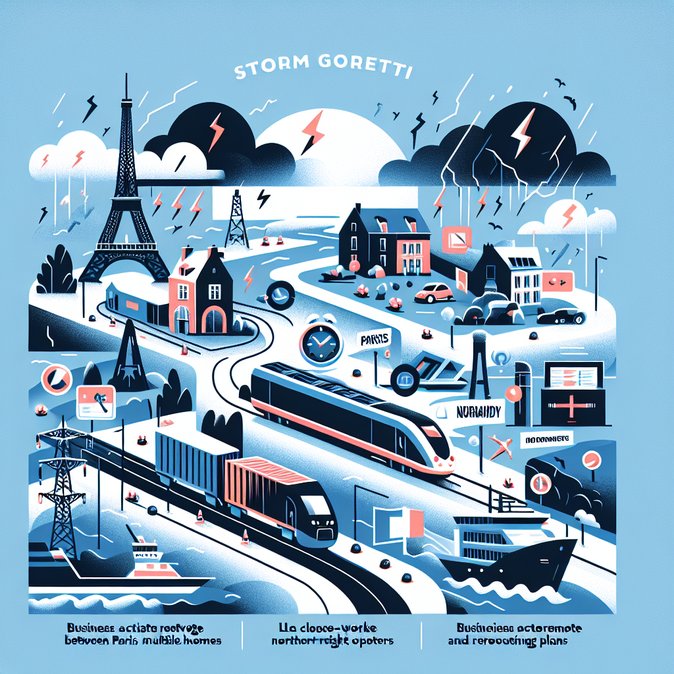
Hurricane-force winds and heavy snow delivered by Atlantic Storm Goretti swept across north-western France overnight on 8–9 January, cutting electricity to more than 380,000 homes in Normandy and Brittany and crippling critical transport links. SNCF suspended every passenger train on the busy Paris-Normandy axis after debris damaged overhead power lines, while regional TER services imposed speed restrictions or stopped altogether. Eurostar warned that knock-on delays would ripple into Paris for at least 24 hours.
The ferocity of the storm was underscored by a record 213 km/h gust measured at Barfleur in the Manche département. Civil-protection units reported at least 28 injuries, and emergency crews spent the night clearing fallen trees from the A13 and A84 motorways. Two reactors at EDF’s Flamanville nuclear plant tripped offline when a high-voltage line went down, although the operator insisted power to hospitals and data-centres remained secure.
![Storm Goretti paralyzes Paris-Normandy rail corridor and ports, forcing companies to activate contingency plans]()
For corporate mobility teams, logistical headaches extend well beyond cancelled train services. Ferries from Cherbourg and Saint-Malo were suspended, and trucking companies rerouted time-critical freight to avoid closed autoroutes. Relocation providers rescheduled orientation visits, while multinationals invoked remote-work protocols for staff based between Rouen and Le Havre. Employers are advising travellers to keep receipts for alternative transport and accommodation so that costs can be recovered under force-majeure clauses.
Météo-France kept 30 départements on orange wind or snow-and-ice alert through Friday evening and warned that black ice would linger into the weekend. SNCF hopes to restart a skeleton service on the Paris–Rouen–Le Havre line by Saturday morning, subject to track inspections, but warned businesses to expect residual disruption until at least Monday.
The episode is the second major weather shock to French mobility in a week and reinforces the need for up-to-date traveller-tracking tools, flexible ticketing policies, and pre-agreed work-from-anywhere protocols—particularly for staff who commute daily between Île-de-France and coastal production sites.
The ferocity of the storm was underscored by a record 213 km/h gust measured at Barfleur in the Manche département. Civil-protection units reported at least 28 injuries, and emergency crews spent the night clearing fallen trees from the A13 and A84 motorways. Two reactors at EDF’s Flamanville nuclear plant tripped offline when a high-voltage line went down, although the operator insisted power to hospitals and data-centres remained secure.

For corporate mobility teams, logistical headaches extend well beyond cancelled train services. Ferries from Cherbourg and Saint-Malo were suspended, and trucking companies rerouted time-critical freight to avoid closed autoroutes. Relocation providers rescheduled orientation visits, while multinationals invoked remote-work protocols for staff based between Rouen and Le Havre. Employers are advising travellers to keep receipts for alternative transport and accommodation so that costs can be recovered under force-majeure clauses.
Météo-France kept 30 départements on orange wind or snow-and-ice alert through Friday evening and warned that black ice would linger into the weekend. SNCF hopes to restart a skeleton service on the Paris–Rouen–Le Havre line by Saturday morning, subject to track inspections, but warned businesses to expect residual disruption until at least Monday.
The episode is the second major weather shock to French mobility in a week and reinforces the need for up-to-date traveller-tracking tools, flexible ticketing policies, and pre-agreed work-from-anywhere protocols—particularly for staff who commute daily between Île-de-France and coastal production sites.
Source: VisaHQ Global Mobility News
How VisaHQ can help
VisaHQ simplifies the visa application process for individuals and businesses. Check current travel requirements, prepare the required documents and manage your application online through the VisaHQ France portal.More From France
View all
EU Entry/Exit System hits Day-90 deadline: biometric capture now mandatory at 50 % of French external borders
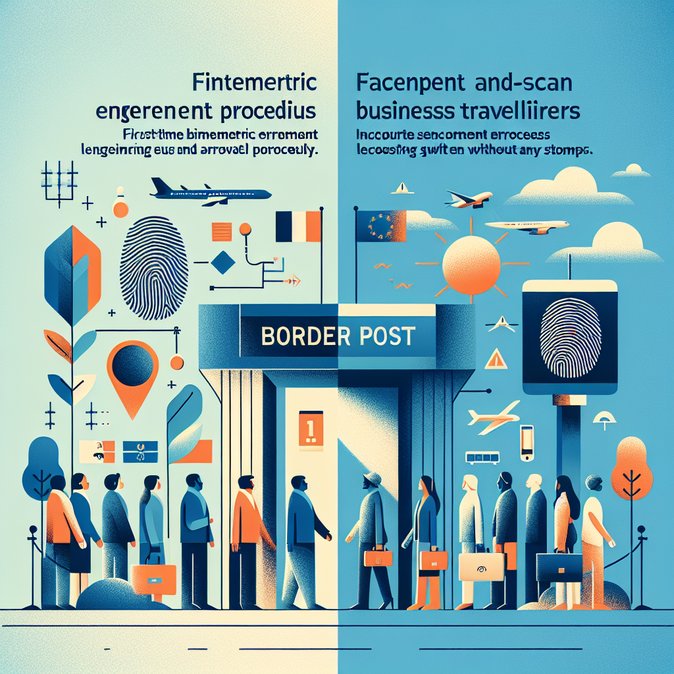
EU Entry/Exit System hits Day-90 milestone: biometric checks now live at half of France’s external border posts