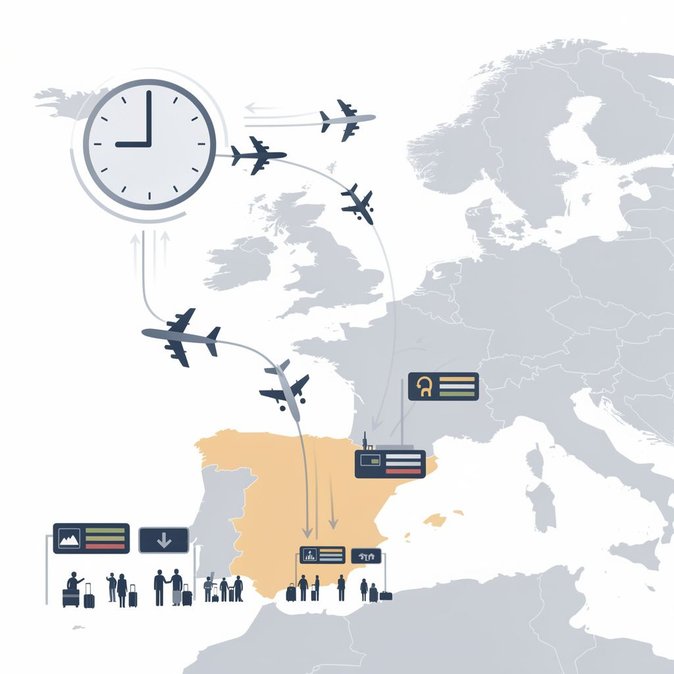
Spain woke up on 12 June to a brand-new European migration landscape. At 00:00 CET the EU’s long-negotiated Migration and Asylum Pact formally replaced the Dublin rules, introducing mandatory biometric screening at external borders, accelerated asylum decisions (target of three months) and new solidarity mechanisms that oblige member states to help partners under migratory pressure. Although the rules apply across the Schengen Area, Spain’s geographic position as one of the EU’s three primary external gateways means the changes will be felt with particular intensity at its airports, ferry ports and land borders in Ceuta and Melilla. For business-travel and global-mobility managers the immediate consequence is operational: carriers must collect passengers’ Advance Passenger Information (API) in a format compatible with the EU Entry/Exit System, and travellers arriving without pre-enrolment may be held in longer secondary-inspection queues while fingerprints and facial images are captured. Spanish officials have advised airlines to warn non-EU nationals connecting through Madrid-Barajas or Barcelona-El Prat that layover times of under 90 minutes could be risky for the next few weeks until passenger flows stabilise. The pact also accelerates return procedures for rejected applicants. Spain’s Interior Ministry has already signed fast-track readmission memoranda with Morocco and Senegal and is negotiating similar deals with Côte d’Ivoire and Guinea. Employers that use short-term posted-worker schemes should confirm that assignees’ residence documents remain valid, as overstays will now trigger an automatic alert in the shared EU-LISA database and could lead to entry bans of up to five years. Human-rights NGOs have criticised the legislation for allowing up to 12 weeks of detention in border “filter centres” before an inadmissible claim is removed. The Spanish government counters that the centres, planned for Almería, Tenerife and Navarra, will reduce pressure on overwhelmed urban reception facilities and speed legitimate cases. Whatever the politics, companies moving staff into Spain this summer should build extra time into onboarding schedules, ensure assignees carry proof of accommodation and sufficient funds, and monitor local press for pilot-phase glitches. With the busy tourist season looming, smooth implementation—or its absence—will set the tone for Spain’s immigration system well into 2027.
Source: TeleMadrid