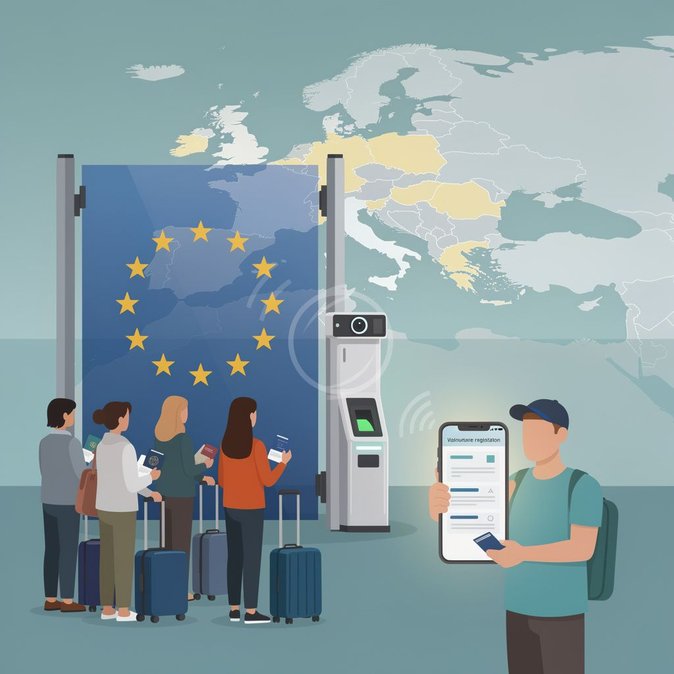
Holidaymakers and business travellers heading from the United Kingdom to mainland Europe were braced for chaos this autumn as the EU’s new Entry/Exit System (EES) of biometric border checks was due to go fully live on 6 September. Instead, nine member states – France, Greece, Portugal, Italy, Germany, Malta, the Netherlands, Belgium and Switzerland – have formally notified Brussels that they need more time to install and test the finger-printing and facial-scan equipment required under the scheme. The delay, first adopted to avoid congestion during major events such as the 2024 Paris Olympics, now reflects practical bottlenecks at airports and seaports. Fewer than 1 % of the EU’s 1,500 border crossing points are still struggling, but these include high-volume gateways such as Frankfurt and Schiphol as well as French police posts in Dover and other UK juxtaposed-control sites. Eurostar terminals in Brussels have begun taking biometrics, yet Paris-Nord and the Port of Dover remain in transition. For UK passport holders—now treated as ‘third-country nationals’ since Brexit—the most immediate benefit is shorter queues at continental airports during the late-summer business-travel peak. The extra time also allows carriers to integrate the EU’s pre-registration ‘Travel to Europe’ smartphone app into their check-in flows. Airlines had warned of “queue chaos”, while the International Air Transport Association (IATA) lobbied for a full suspension earlier this year. The Commission has indicated the deferral will not trigger infringement proceedings, but industry insiders say a hard deadline is now likely to be linked to mid-2027 Schengen IT upgrades. UK firms with frequent-traveller programmes are being advised to brief staff that biometric capture will become mandatory and that overstays will be automatically flagged within the shared EU database—an issue already affecting some Britons who breached the post-Brexit 90/180-day rule. Practically, corporate mobility teams should update travel policies to: (1) include extra time for enrolment once EES goes live; (2) remind UK employees that registering fingerprints does not reset the Schengen day-counter; and (3) confirm that passports with at least six months’ validity remain essential even for short trips undertaken on an Electronic Travel Authorisation (ETIAS) once that system launches. Forward-thinking organisations are trialling the ‘Travel to Europe’ app where available to pre-clear staff and reduce dwell time at kiosks.
Source: The Guardian