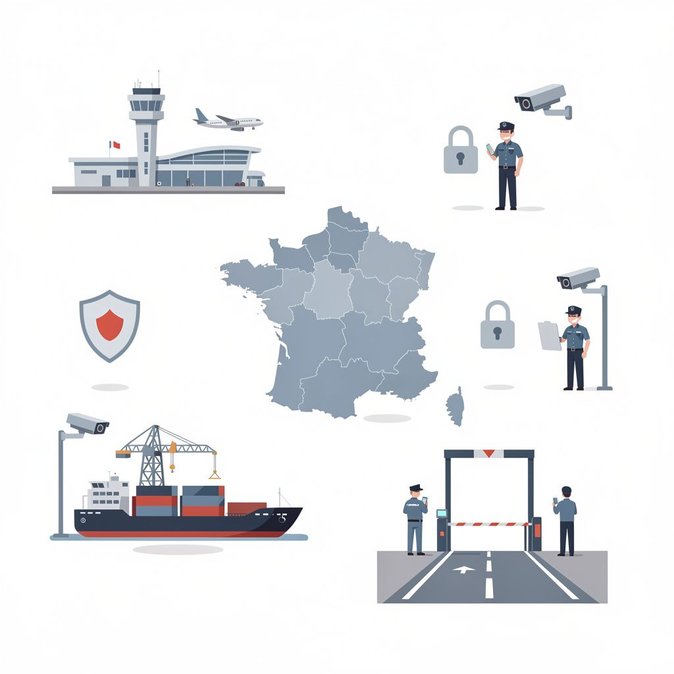
France has raised its national security posture after President Emmanuel Macron convened party leaders in the Elysée Palace crisis room late on Friday, 18 September, to brief them on a surge in suspected Russian “hybrid” operations. According to officials present, intelligence chiefs from the DGSE and DGSI cited a growing pattern of drone incursions, cyber-intrusions and small-scale acts of sabotage against energy, transport and defence sites across Europe. The president told attendees that “any hostile action on French soil will not go unanswered” and ordered an immediate plan to harden protections around airports, rail hubs, data centres, ports and arms factories. For global mobility managers the most visible measure will be tighter perimeter controls at airports such as Paris-Charles-de-Gaulle, Lyon Saint-Exupéry and Toulouse-Blagnac, where additional gendarmerie units and unmanned aerial-defence systems are being deployed. Commercial pilots have been told to expect short-notice air-space restrictions should unidentified drones be detected within 5 nautical miles of runways. Freight forwarders moving sensitive dual-use goods out of the ports of Le Havre and Marseille have been advised to submit cargo manifests 12 hours earlier than usual while the Directorate-General of Customs (DGDDI) adds extra screening. The Interior Ministry has also re-tasked 300 mobile gendarmes to reinforce land-border posts along the Franco-German and Franco-Italian frontiers, citing the risk that saboteurs could exploit busy weekend crossings. Travel industry bodies, including the National Federation of Passenger Transport, warn that spot checks may lengthen coach and shuttle processing times, especially on the A40 and A43 alpine corridors that carry seasonal workers between France and northern Italy. The business community broadly supports the measures. MEDEF’s security working group noted that France hosts Europe’s largest aerospace-defence supply chain and is therefore a high-value target. Corporations have been urged to update staff travel security briefings and to map alternative routes in case key high-speed rail arteries are interrupted. International assignment teams are also being reminded to ensure that employee passports and long-stay permits are carried at all times, as random identity checks on inter-city trains are expected to increase. Although officials insist daily life should remain largely unaffected, they concede that the hybrid-warfare threat is now a long-term reality. Mobility professionals should monitor prefectural notices and be prepared for rapid, locality-specific restrictions—particularly around strategic industrial zones such as Cherbourg, Brest and Toulon, or during major events like the forthcoming France-Italy G7 summit in Evian.
Source: ABC News