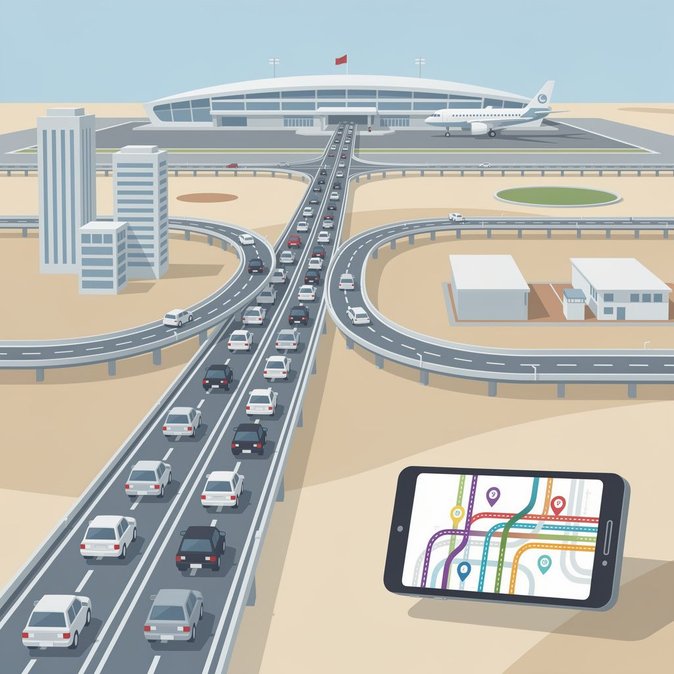
Commuters experienced an old-school grind rather than high-tech turbulence on 22 September as heavy traffic clogged arteries connecting Dubai and Sharjah. Algulf News reporters pinpointed Ras Al Khor Industrial Area—specifically the E66-E44 interchange—as the worst bottleneck, while parallel delays stretched along Deira’s feeder roads to Dubai International Airport (DXB) and on to Al Garhoud Bridge. The Roads and Transport Authority has recently added lanes and re-profiled junctions on Ras Al Khor Road, boosting theoretical capacity by 20 per cent. Yet the Tuesday rush showed infrastructure upgrades cannot always out-run population growth, school reopening and construction lorries feeding Dubai’s real-estate boom. Sharjah’s Al Khan Corniche and the Industrial Area 17 node similarly backed up, slowing thousands of inter-emirate commuters who rely on E311 and E611 to reach Dubai’s business districts. For corporate mobility programmes the impact is immediate: airport transfers that normally take 15-20 minutes from Downtown stretched to 40-50 minutes. Travel-management companies therefore advised passengers on tight morning departures to leave at least an extra 30 minutes and to track Waze or RTA’s S’hail app in real time. Employers with large blue-collar workforces reported late clock-ins and are reviewing staggered shift options. Longer-term, Dubai Airports and RTA are stepping up coordination. On 17 September the two entities met to map traffic-flow data into the airport’s demand-forecasting software so that curb-side congestion and check-in staffing can be adjusted dynamically—a micro-example of the smart-city integrations Dubai touts ahead of Expo 2030 bid judging. Until then, the simplest remedy for travellers is old fashioned: leave early, avoid last-second lane changes and keep boarding passes handy in case of curb-side security spot-checks triggered by the heightened regional threat environment.
Source: Algulf News