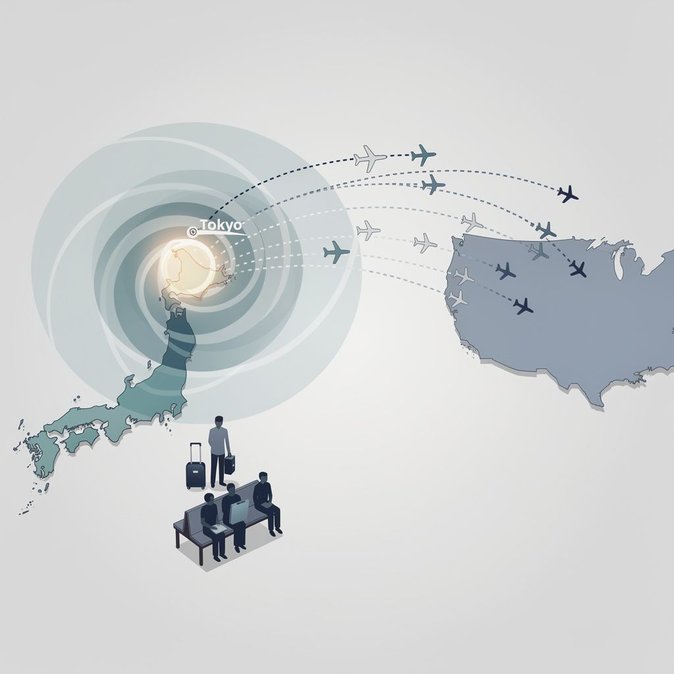
Typhoon Dujuan swept past the Tokyo metropolitan area late Monday, September 21 (JST), unleashing record rainfall and prompting airlines to cancel more than 500 flights at Haneda and Narita airports—including virtually every nonstop service to the United States. United, American, Delta, Japan Airlines (JAL) and All Nippon Airways collectively scrubbed at least 32 trans-Pacific sectors, affecting an estimated 9,000 passengers. For U.S. multinationals, the timing could not be worse. The storm coincides with Japan’s “Silver Week” holidays, traditionally a period of intensified client meetings and factory audits as companies close their third-quarter books. Semiconductor manufacturers in Arizona and Texas awaiting critical components from suppliers in Ibaraki and Kanagawa reported delays of up to 48 hours, forcing some plants onto overtime schedules to avoid production bottlenecks. Several Wall Street banks re-routed Asia-based executives through Seoul and Taipei to make Wednesday’s United Nations General Assembly side events in New York. Airlines have issued broad travel waivers allowing passengers ticketed through September 25 to rebook without fees. However, premium-cabin inventory is already constrained because of capacity caps linked to ongoing U.S. pilot shortages, leaving corporate travel managers little room to maneuver. Freight forwarders warn that air-cargo rates on Japan-U.S. lanes could spike by 15-20 percent this week as shippers compete for belly-hold space once operations resume. The episode is a reminder that natural-hazard disruption in Asia quickly reverberates across North American supply chains and executive-mobility plans. Experts recommend that companies with frequent Japan travel maintain contingency playbooks that include pre-approved alternative routings via West-Coast gateways, pre-negotiated hotel blocks near Tokyo airports, and standing relationships with charter operators for urgent personnel moves. Firms should also review employee communications protocols to ensure staff receive both local Japanese government evacuation alerts and U.S. embassy advisories in real time. Meteorologists expect Dujuan to weaken over the Pacific by Wednesday, allowing carriers to reposition aircraft and clear backlogs—but residual schedule irregularities could linger through the weekend. Travelers heading to or from Japan should monitor airline apps and enrollment in Smart Traveler Enrollment Program (STEP) notifications for the latest guidance.