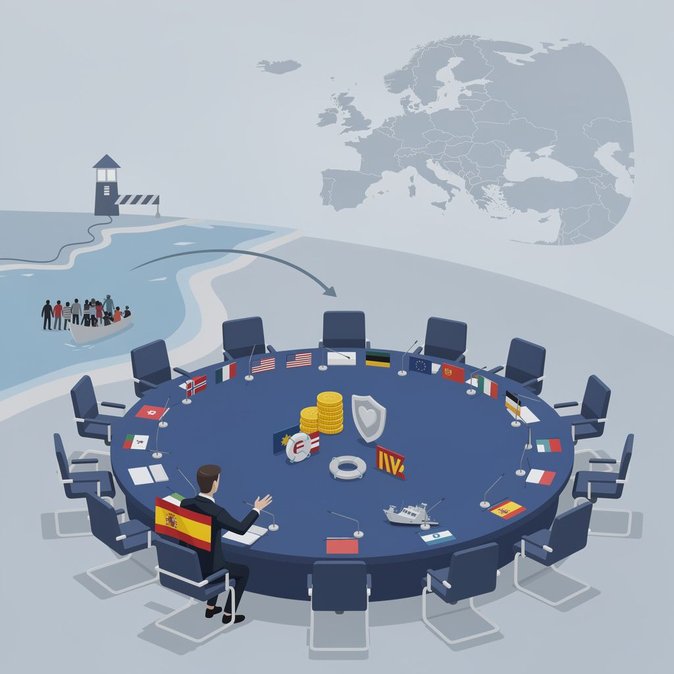
Speaking to his EU counterparts at the Justice-Home Affairs Council in Luxembourg on 1 October, Interior Minister Fernando Grande-Marlaska delivered an unusually blunt assessment of how the bloc handled this summer’s mass crossing of 70-80 000 migrants into Spain’s North African city of Ceuta. According to Grande-Marlaska, not a single migrant from the 30-31 July surge has reached another Member State, yet 22 governments swiftly criticised Madrid while offering scant operational help. The minister used the debate on the ‘State of Schengen’ to demand what he called “operational, financial and political solidarity”. He reminded colleagues that Spain has registered the second-highest number of return decisions in the EU since 2021 and is already piloting 100 % EES biometric capture at major airports. Spain’s own irregular arrivals are down 46 % overall—and 74 % in the Canary route—thanks to reinforced cooperation with Morocco and West-African states. Grande-Marlaska also pushed back against Italy’s decision to keep border checks on arrivals from Spain, arguing that the Schengen Borders Code permits temporary suspensions only when strictly necessary. His remarks came as Madrid itself continues reciprocal controls on flights and ferries from Italy until at least 8 October. EU Home-Affairs Commissioner Magnus Brunner acknowledged that the rules allow such measures but hinted that the Commission is monitoring their proportionality. For mobility managers, the intervention signals that Spain will lobby hard for EU co-funding of reception centres, faster return procedures and a common contingency mechanism—changes that could reduce ad-hoc border checks that disrupt corporate travel. Businesses moving staff through Spanish hubs should nevertheless expect spot controls, especially on itineraries touching Italy, until the political stand-off eases. In the medium term, Spain’s insistence on burden-sharing could shape the final text of the New Pact on Migration and Asylum, influencing visa issuance priorities, carrier sanctions and digital border projects such as the Entry/Exit System (EES) and ETIAS. Companies with large assignee populations in Spain should track these negotiations, as funding decisions will determine how quickly Schengen returns to friction-free movement after the summer’s shock.