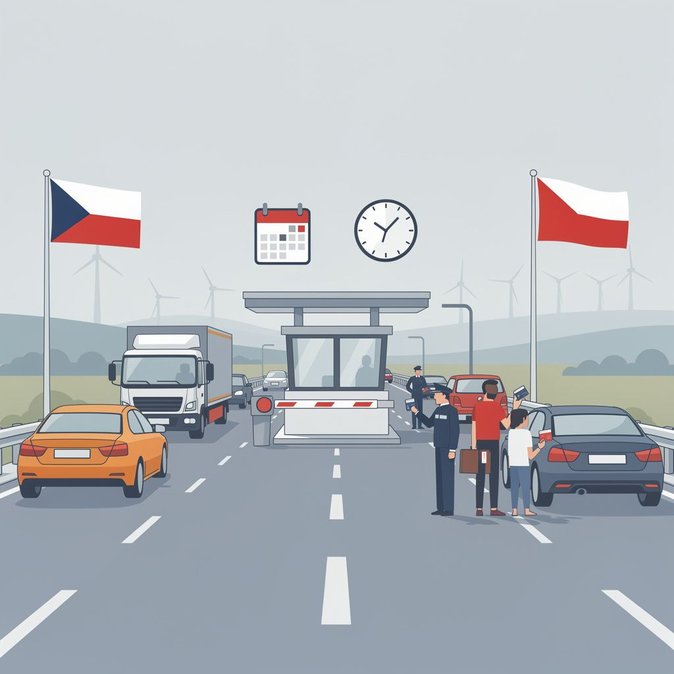
Austria has officially notified the European Commission that it will keep temporary controls in place at all land border crossings with the Czech Republic and Slovakia until 15 March 2027. The measure is part of a six-month extension of internal Schengen checks that entered into force on 16 September 2026 and is justified by Vienna as a response to continuing irregular migration pressures, the strain on Austria’s asylum-reception system and wider security risks linked to Russia’s war in Ukraine and instability in the Middle East. For Czech companies with operations or suppliers across the southern frontier, the extension means that trucks, company cars and commuter coaches will continue to face spot checks and occasional queues at busy crossing points such as Wullowitz/Dolní Dvořiště and Drasenhofen/Mikulov. Logistics associations on both sides of the border report that waiting times have stabilised at 20–40 minutes for freight but can spike during harvest and pre-Christmas peaks. Business travellers are advised to factor potential delays into itineraries and to carry passports or national ID cards even for day trips. Cross-border commuters—an estimated 15,000 Czech residents work in Austria—must also be prepared for random inspections. Employers with posted workers should keep assignment letters and A1 social-security forms on hand to avoid fines. Austrian federal police have indicated they will continue to use mobile license-plate recognition vans and drones near secondary roads to deter evasion. Because the controls are classed as a “temporary re-introduction” under Articles 25–29 of the Schengen Borders Code, they are reviewed every six months. However, Vienna has now been rolling them over since 2015; legal experts warn that prolonged use may invite litigation if proportionality cannot be demonstrated. The Czech Foreign Ministry said it would “closely monitor the impact on citizens and haulage firms” but stopped short of announcing reciprocal checks. Travel-risk consultants recommend scheduling early-morning or late-evening crossings, using less-congested points such as Gmünd/České Velenice, and signing up to real-time traffic feeds provided by the Czech Directorate of Roads and Motorways. Air and rail services between Prague and Vienna remain unaffected.