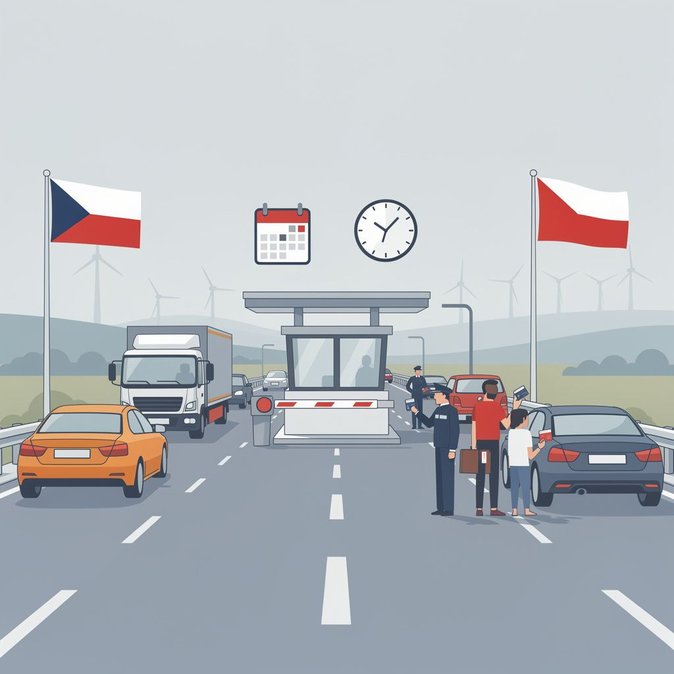
Travellers driving between Austria and Czechia will continue to encounter ad-hoc passport inspections well into next year after Vienna quietly prolonged its internal-Schengen border measures. An 8 October 2026 update to Austria’s notification in the European Commission’s public register confirms that the current regime—mobile patrols that can stop vehicles anywhere within the wider border zone—has been rolled over from the previous expiry of 15 September 2026 to 15 March 2027. Austria first re-introduced controls on its borders with Slovenia, Hungary, Slovakia and Czechia in 2015 at the height of the refugee crisis. The policy has since been renewed every six months. What has changed is the operational model. Since June 2026, fixed checkpoints at crossings such as Wullowitz/Dolní Dvořiště have largely been replaced by roving units equipped with licence-plate cameras and biometric readers, reducing queues but increasing unpredictability for motorists. For Czech-based companies running shuttle buses or just-in-time deliveries to Linz and Vienna, the shift means drivers must carry passports (or national ID cards) at all times and build extra buffer time into schedules. Although these are “internal” Schengen checks, carriers remain liable for ensuring that non-EU passengers have valid visas or residence permits. Czech police do not plan reciprocal controls but have asked transport operators to monitor delays and report any systematic hold-ups. The European Commission has repeatedly urged member states to phase out such long-term internal checks, arguing that the Entry/Exit System (EES) introduced in April 2026 provides sufficient oversight of who enters and leaves the Schengen Area. Vienna counters that irregular migration along the Balkan route and security concerns justify the measures. Negotiations on a Schengen Borders Code reform, which could tighten the rules for extensions, remain stalled in the Council. Practical tip: business travellers should keep originals of their passports, proof of accommodation and, for third-country nationals, Czech residence cards in the vehicle, not in checked luggage. EU citizens may use a national ID card, but a phone photo is not accepted. HR teams should brief employees that a “green light” at the physical border no longer guarantees an uninterrupted trip; random patrols up to 20 km inside Austria are now the norm.