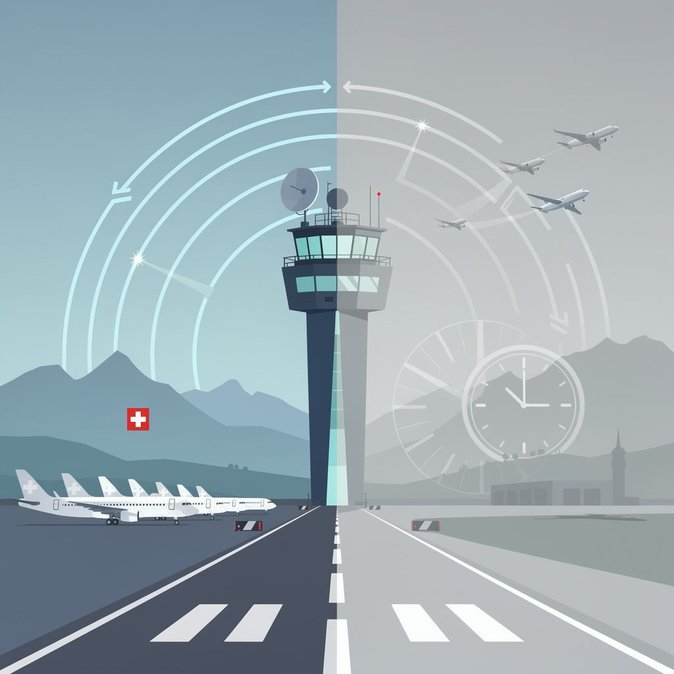
Swiss air navigation service provider Skyguide was forced to impose severe flow restrictions on 20 October 2026 after a fault in the system that generates radar images for controllers knocked out half of the country’s air-traffic-management capacity. According to a Reuters flash, departures and arrivals at Zurich (ZRH) and Geneva (GVA) were briefly suspended during the early morning, before operations resumed under a 50 % slot-allocation regime designed to keep traffic volume within safe limits. Skyguide stressed that there was no indication of a cyber-attack; engineers traced the problem to a corrupted software module in the display-generation chain. A crisis cell was convened with the Federal Office of Civil Aviation (FOCA) and airport operators to coordinate contingency procedures, including tactical rerouting of over-flights to German and Italian upper-air-space sectors. For corporate travellers the timing could hardly have been worse: 20 October is one of the busiest days of the autumn conference calendar in Switzerland, with delegates converging on Baselworld and several UN meetings in Geneva. Travel-management companies reported average delays of 45-90 minutes and advised clients to build in at least a four-hour buffer for same-day connections. Cargo operators also faced knock-on effects, as reduced arrival rates limited belly-hold capacity for time-critical pharmaceutical shipments. The incident is a reminder of the fragility of Europe’s dense air-traffic network. Switzerland was hit by a complete Skyguide outage in June 2022 that closed its airspace for several hours; while post-event reviews led to major hardware redundancies, today’s event shows that single points of software failure remain a risk. Skyguide says a permanent software patch and additional sandbox testing will be implemented before the Christmas peak. Travellers holding fully flexible tickets on SWISS, easyJet Switzerland and Helvetic Airways may rebook without fees through 23 October. Those with tight onward connections are being encouraged to consider rail alternatives such as the TGV-Lyria service to Paris or SBB’s high-frequency links to Milan and Munich.
Source: Reuters (via MarketScreener)