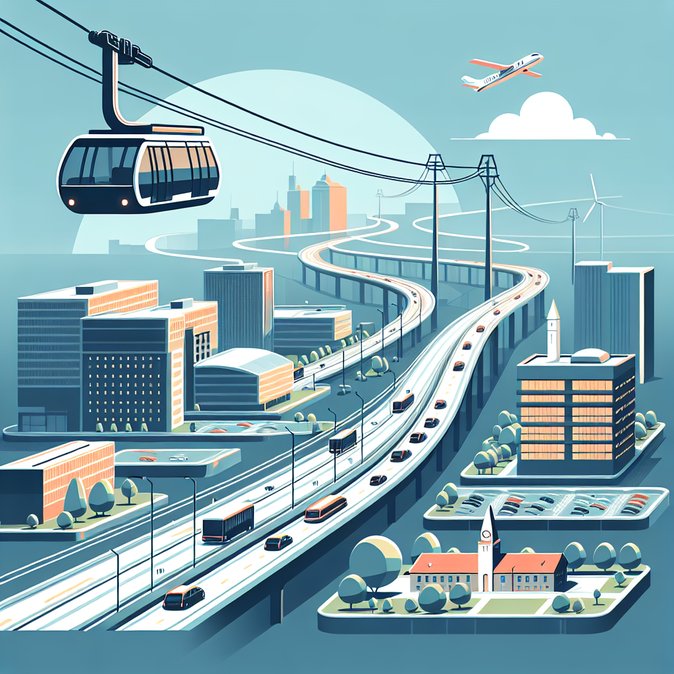
At precisely 11:00 on 13 December, the first ten-seater gondola of the Câble C1 floated above the rail yards of Créteil, inaugurating France’s first modern urban cable-car line. Spanning 4.5 km and four stations, the aerial route links the underserved suburbs of Créteil, Limeil-Brévannes, Valenton and Villeneuve-Saint-Georges in just 17 minutes—less than half the journey time of local buses that often suffer congestion on the A86 ring road.
Funded by Île-de-France Mobilités at €132 million and operated by Transdev, the system is fully integrated into the Navigo fare structure; passengers simply tap the same contactless card used on the Métro and RER. Projected daily ridership of 11,000 includes hospital staff commuting to the Henri-Mondor medical campus, students attending the biocluster south-east of Paris and expatriate families for whom traditional public transport options were patchy.
![Île-de-France debuts Câble C1, integrating an urban cable car into the region’s public-transport network]()
From a global-mobility perspective, the cable car offers a reliable, congestion-proof link between affordable residential districts and key employment zones—a boon for companies struggling with Greater Paris housing costs and “last-mile” transport challenges for international assignees.
The cabins are wheelchair-accessible, equipped with CCTV and Wi-Fi, and designed to operate even in 100 km/h winds—crucial redundancy with winter storms increasingly common. Authorities are already studying extensions toward the Orly airport-bound tram T9 and the future Métro Line 15.
Employers may wish to update relocation handbooks and commuter-benefit policies to highlight the new mode, which is open daily from 05:30 to 00:30 and offers panoramic views of the Marne valley—an unexpected perk for visiting executives.
Funded by Île-de-France Mobilités at €132 million and operated by Transdev, the system is fully integrated into the Navigo fare structure; passengers simply tap the same contactless card used on the Métro and RER. Projected daily ridership of 11,000 includes hospital staff commuting to the Henri-Mondor medical campus, students attending the biocluster south-east of Paris and expatriate families for whom traditional public transport options were patchy.

From a global-mobility perspective, the cable car offers a reliable, congestion-proof link between affordable residential districts and key employment zones—a boon for companies struggling with Greater Paris housing costs and “last-mile” transport challenges for international assignees.
The cabins are wheelchair-accessible, equipped with CCTV and Wi-Fi, and designed to operate even in 100 km/h winds—crucial redundancy with winter storms increasingly common. Authorities are already studying extensions toward the Orly airport-bound tram T9 and the future Métro Line 15.
Employers may wish to update relocation handbooks and commuter-benefit policies to highlight the new mode, which is open daily from 05:30 to 00:30 and offers panoramic views of the Marne valley—an unexpected perk for visiting executives.
Source: VisaHQ Global Mobility News