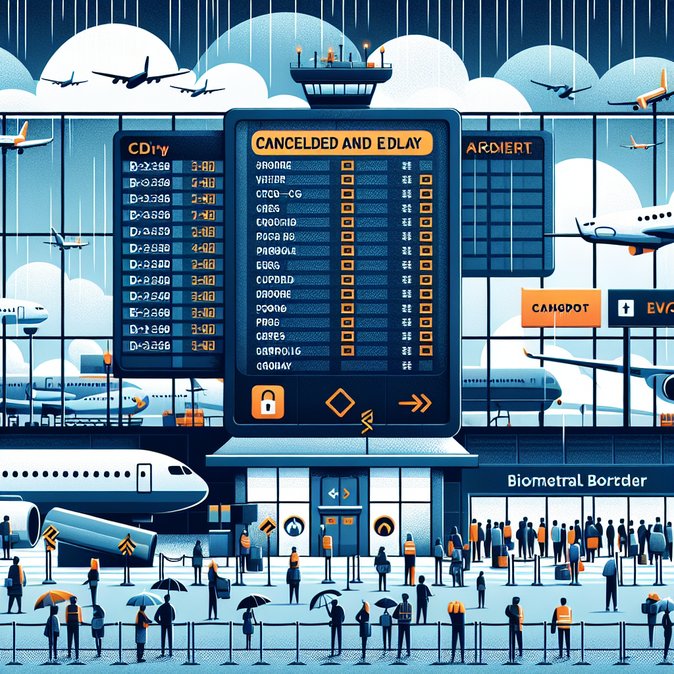
A potent mix of winter storms sweeping across Western Europe, air-traffic-control (ATC) spacing restrictions and persistent ground-handling staff shortages combined on 13 December to create one of the worst pre-Christmas travel days of the season. According to flight-data platform Cirium, 85 flights were cancelled and more than 1,080 delayed in the 24-hour period, with Paris-Charles-de-Gaulle (CDG) and Paris-Orly (ORY) ranking among the continent’s five hardest-hit hubs.
Air France trimmed seven long-haul rotations, while British Airways, easyJet and KLM all axed intra-European sectors that typically carry weekend city-break traffic and connecting business travellers. The disruptions come at a sensitive moment: France is gradually rolling out new biometric passport-control kiosks ahead of the EU Entry/Exit System (EES) go-live in October 2025, and passengers reported that unfamiliar self-service procedures magnified queue times once weather-related holding patterns eased.
![Severe weather and staffing shortages trigger wave of flight cancellations and delays at Paris-CDG and Orly]()
Ground-handling unions blamed chronic understaffing, saying rosters are still 12–15 % below 2019 levels. Paris Aéroports urged airlines to “pre-emptively rebalance” schedules and asked employers to offer overtime incentives through 7 January. Travel-risk consultants Advito advise corporate travel managers to build 90-minute buffers for onward rail connections and to book flexible fares where possible.
Cargo flows were also affected: FedEx temporarily rerouted two wide-body freighters from CDG to Liège because peak-hour slot constraints threatened to push crew beyond duty limits. That diversion could delay just-in-time spare-parts deliveries for French manufacturing plants already operating on reduced holiday staffing.
Looking ahead, the French Civil Aviation Authority (DGAC) said it will hold a stakeholder call on 16 December to review contingency staffing levels through the end-of-year peak. Companies with travellers or time-critical shipments should monitor NOTAMs and DGAC communiqués and keep travellers informed via mobile alerts.
Air France trimmed seven long-haul rotations, while British Airways, easyJet and KLM all axed intra-European sectors that typically carry weekend city-break traffic and connecting business travellers. The disruptions come at a sensitive moment: France is gradually rolling out new biometric passport-control kiosks ahead of the EU Entry/Exit System (EES) go-live in October 2025, and passengers reported that unfamiliar self-service procedures magnified queue times once weather-related holding patterns eased.

Ground-handling unions blamed chronic understaffing, saying rosters are still 12–15 % below 2019 levels. Paris Aéroports urged airlines to “pre-emptively rebalance” schedules and asked employers to offer overtime incentives through 7 January. Travel-risk consultants Advito advise corporate travel managers to build 90-minute buffers for onward rail connections and to book flexible fares where possible.
Cargo flows were also affected: FedEx temporarily rerouted two wide-body freighters from CDG to Liège because peak-hour slot constraints threatened to push crew beyond duty limits. That diversion could delay just-in-time spare-parts deliveries for French manufacturing plants already operating on reduced holiday staffing.
Looking ahead, the French Civil Aviation Authority (DGAC) said it will hold a stakeholder call on 16 December to review contingency staffing levels through the end-of-year peak. Companies with travellers or time-critical shipments should monitor NOTAMs and DGAC communiqués and keep travellers informed via mobile alerts.
Source: VisaHQ Global Mobility News