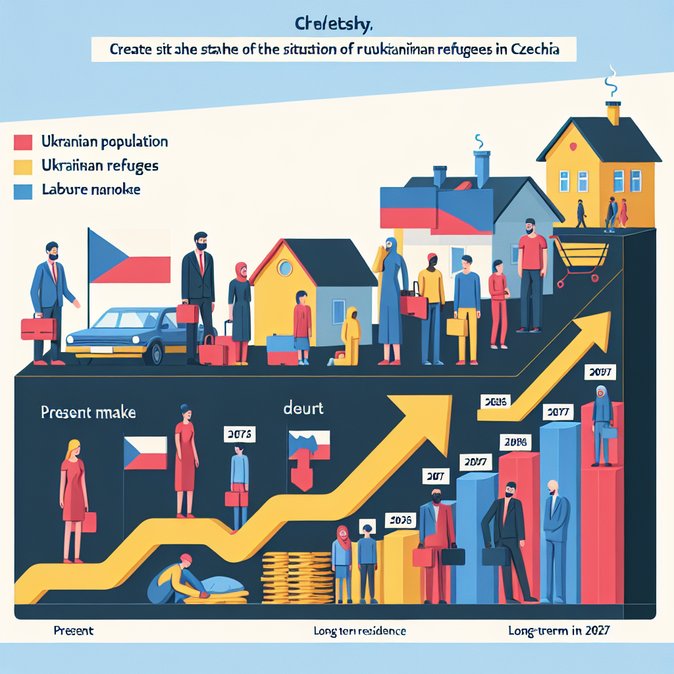
A three-day fact-finding mission by the Council of Europe’s Division on Migration and Refugees (DMR) wrapped up in Prague on 24 April after a packed agenda of meetings with the Interior, Labour, Education and Human Rights ministries, UNHCR, IOM and leading NGOs. The delegation came to gauge how Czechia – the EU country hosting the highest per-capita number of people fleeing Russia’s war on Ukraine – is preparing for the 2027 expiry of Temporary Protection (TP) and the roll-out of the new “Ukraine Law VII.” Officials told the DMR that roughly 382,000 Ukrainian nationals now live in Czechia, 90 % of refugee children attend local schools and about 80 % of adults are economically active. Under Ukraine Law VII, TP holders will be able to convert to standard long-term residence if they meet minimum income, housing and insurance thresholds. Regional migrant-integration centres are being expanded and a dedicated Ukrainian Consultation and Community Centre has just opened in Prague to provide legal counselling, job-matching and language courses. The DMR praised Prague’s “whole-of-government” approach, which includes accelerated Czech-language classes, fast recognition of Ukrainian professional qualifications and targeted labour-market programmes for health-care, construction and IT workers. Officials nonetheless warned that capacity bottlenecks in residence-permit processing could emerge in 2027 unless staffing and digital-workflow upgrades are funded in the 2027-29 state budget. For employers, the mission’s findings translate into practical advice: start auditing the immigration status of all Ukrainian staff now and budget time for status-change applications in late-2026. HR teams should also monitor forthcoming Interior-Ministry decrees detailing documentary evidence and fee levels for the new long-term permits. Failure to switch in time could leave workers – and the companies that rely on them – in an irregular-stay limbo. More broadly, the Council of Europe will publish a handbook later this year highlighting Czechia’s integration model as a blueprint for other EU states facing large refugee inflows. The handbook will focus on multi-agency coordination, rapid labour-market activation and the use of EU funds for language training and child-care, areas where corporate mobility managers can push for similar support in other jurisdictions.