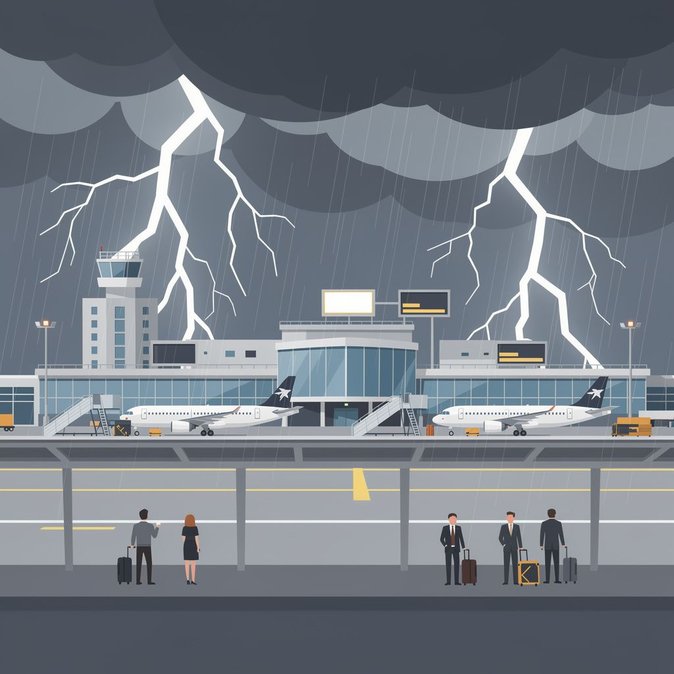
A violent clash between humid Atlantic air and the week-long European heatwave produced electrical storms over south-east England on the evening of 29 June, paralysing operations at London Heathrow (LHR) and Gatwick (LGW). According to flight-tracking service FlightAware, 474 Heathrow departures and arrivals were delayed and 55 cancelled; Gatwick recorded 439 delays and 38 cancellations. Some passengers reported ground holds of up to 11 hours as lightning cells repeatedly triggered air-traffic-control flow restrictions. Both airports suspended ramp operations for cumulative periods exceeding three hours to protect ground staff from lightning strikes—a Health & Safety Executive requirement introduced after a near-miss in 2024. When operations resumed, backlogs were compounded by crew-duty-time limits and slot re-sequencing across Eurocontrol’s network, leaving long-haul connections particularly vulnerable. British Airways cancelled its late Hong Kong and Singapore departures, while easyJet diverted two Mediterranean rotations to Manchester and Birmingham. For employers, the disruption is a reminder that UK airspace remains weather-sensitive despite post-Brexit ATC modernisation projects. Travellers whose flights were cancelled are entitled to EU/UK261 rerouting or reimbursement, but thunderstorms are deemed “extraordinary circumstances”, so fixed compensation ( £220–£520) does not apply. HR teams should still encourage employees to keep receipts for meals and overnight accommodation, which airlines must cover. Meteorologists at the Met Office warn of further convective storms into the first week of July. Firms with time-critical mobility moves—such as expatriate families scheduled to arrive for July rent starts—should consider flex boarding dates or use regional alternatives like Birmingham or Paris-CDG plus Eurostar (subject to separate rail issues).
Source: Nomad Lawyer Travel Desk