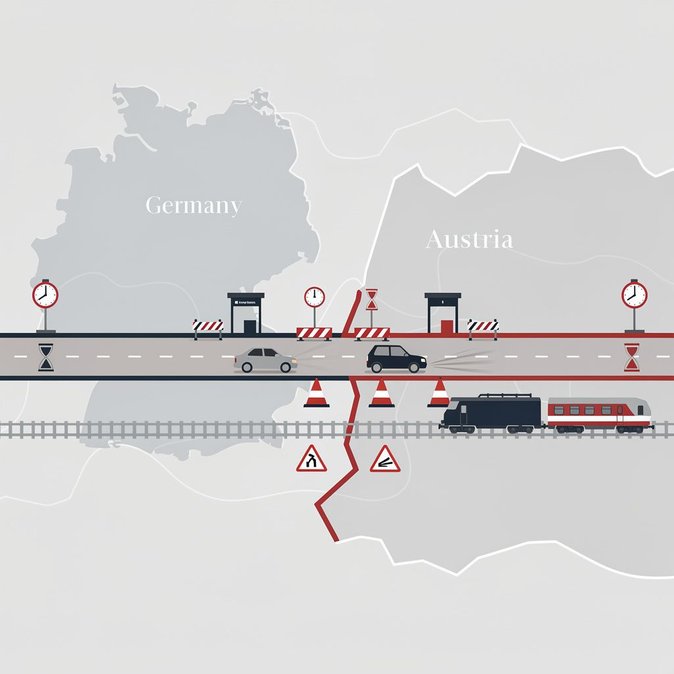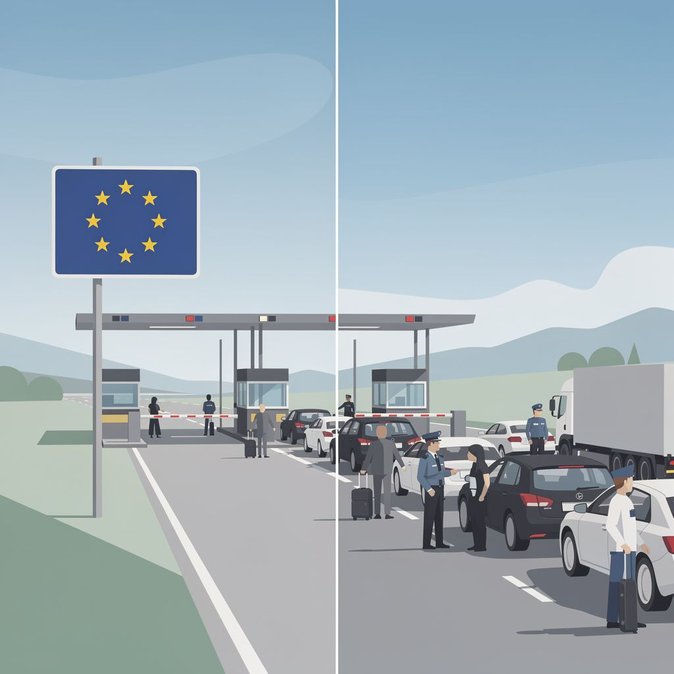
The long-running temporary border controls at the Walserberg crossing on the A1 motorway and at several secondary crossings between the Austrian federal state of Salzburg and the German state of Bavaria will remain in force. Austrian Interior Minister Gerhard Karner and his German counterpart Nancy Faeser confirmed at the weekend that the joint regime—first introduced during the 2015–2016 migration crisis—will be prolonged on security grounds. According to German Federal Police figures cited by ORF, roughly 3,000 people were turned back at the Salzburg-Bavaria frontier in 2025, a third fewer than the year before. While EU Migration Commissioner Magnus Brunner (AT) argues that illegal border crossings have fallen by 37 % in the first half of 2026 and that the controls should therefore be lifted, both interior ministers believe the measures are still needed to deter people-smuggling networks and identify fugitives on international watch-lists. For travellers the decision means continued queues that can stretch for kilometres during the summer holiday season. In an on-site survey conducted by ORF, a clear majority of holiday-makers from Germany, Austria and Italy said they would welcome a return to normal Schengen-area free movement, complaining that delays cost them time and fuel and make cross-border tourism less attractive. Business-travel stakeholders are equally concerned. Logistics firms moving goods between southern Germany and Austria’s industrial hubs warn that unplanned inspections can add hours to delivery schedules and raise costs. Tourism operators fear that persistent congestion could discourage overnight visitors who generate significant revenue for Salzburg’s hospitality sector. Although the European Commission has repeatedly urged member states to phase out long-term internal border checks, Brussels can do little more than issue opinions. With France, Italy, Denmark, Slovenia and Sweden also operating exceptional regimes, the fate of Schengen’s once-frictionless interior borders now depends largely on national political calculations about migration and security. Companies with time-sensitive supply chains or staff who commute across the frontier should continue to factor in possible delays and keep alternative routing options on standby.
Source: ORF Salzburg