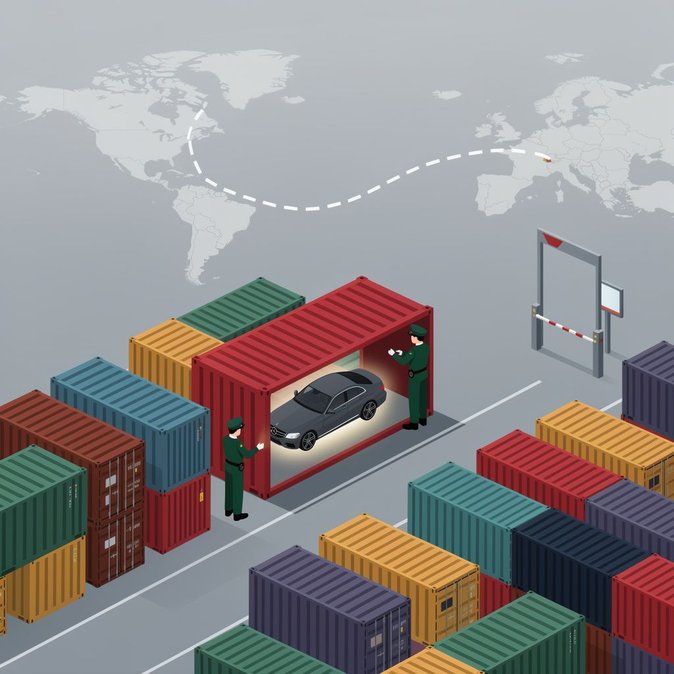
Poland’s eastern frontier again proved pivotal for European border security on 23 July when officers of the Nadbużański Border Guard, supported by customs agents, discovered a 2017 Mercedes-Benz C 300 Coupé hidden inside a freight container on a Canada–Europe rail shipment routed through the Port of Gdańsk. Interpol records showed the car had been reported stolen in Ontario five months earlier. Its black-market value, even after collision damage, is estimated at PLN 60,000 (€13,700). Investigators believe organised crime groups are exploiting Poland’s position as the EU’s eastern gateway to funnel North-American luxury vehicles toward buyers in Ukraine, Belarus and Russia. Most consignments arrive legally by sea, are transhipped to rail or road, then attempt a final sortie across Poland’s land border hidden among “household goods” or “relocation cargo”. The haul highlights how rail freight — celebrated for its lower carbon footprint — is increasingly targeted by smugglers. Polish authorities say detections of stolen Canadian vehicles have doubled since 2024, mirroring a surge in car-theft rings operating around the Port of Montreal. Yet only “a few dozen” are intercepted annually, suggesting significant dark figures. For mobility and relocation specialists the episode signals tougher scrutiny at rail and road border crossings. Companies moving personal vehicles into or through Poland should expect longer inspection windows and ensure VIN documentation matches Canadian export declarations. Logistics providers are advised to monitor the EU’s Schengen Information System (SIS) alerts more closely and build extra lead time into delivery schedules east of Warsaw. Legally the case will be handled by the district prosecutor in Zamość; if ownership is confirmed, the vehicle will be repatriated under the EU–Canada Mutual Legal Assistance Treaty. Border Guard headquarters in Warsaw is meanwhile lobbying for an expanded car-crime task-force to share intelligence with Canadian police and shipping lines.
Source: Auto Świat