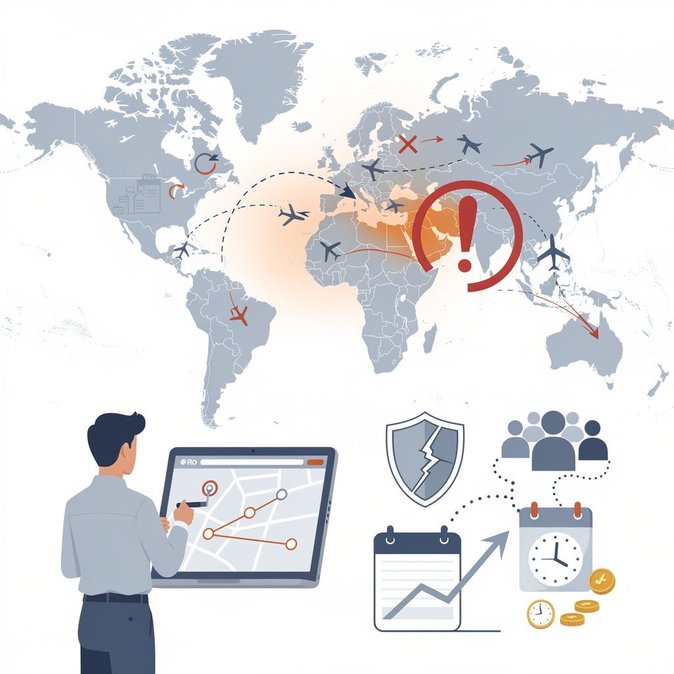
Australia’s Department of Foreign Affairs and Trade (DFAT) overnight refreshed its region-wide Middle-East Conflict Alert, upgrading advice for several locations and reaffirming a blanket “Do Not Travel” warning for Bahrain, Iran, Iraq, Kuwait, Lebanon, Palestine, Syria and Yemen. The bulletin, time-stamped 25 July 2026, cites a sudden escalation of missile strikes and retaliatory attacks across multiple borders and warns that airports, energy infrastructure and foreign business interests are now active targets. DFAT stresses that commercial flight schedules may collapse without notice if airspace is closed and urges Australians already in the region to have an immediate departure plan. Travellers are told not to head to the airport until airlines confirm that flights are operating and local authorities deem routes safe. The advisory also lists land-border closures and curfews as likely, complicating overland evacuation options. For Australian corporates the refreshed warning has material consequences. Under most travel-risk policies, “Level 4 – Do Not Travel” destinations automatically invalidate company insurance and trigger duty-of-care escalation. Mobility managers will need to track all assignees, contractors and dependants in the wider region—including Israel, Jordan, Oman, Qatar, Saudi Arabia and the UAE, now rated “Reconsider your need to travel”—and prepare contingency flights through third-country hubs such as Athens or Istanbul. Airlines have already begun rerouting Sydney–London services further south to avoid hostile airspace, adding hours of extra flying time and crew-duty complexity. HR leaders should also scan expatriate allowances and hardship premiums: a five-day airport closure could trigger contractual evacuation clauses, temporary accommodation costs and mental-health support obligations. DFAT’s alert explicitly links to its business-traveller security resources, underscoring the federal expectation that employers shoulder primary responsibility for staff welfare. Practical next steps include pushing real-time alerts via traveller-tracking apps, locking new bookings to low-risk transit points (eg, Dubai flights that can be ticket-changed to Muscat or Doha) and updating crisis-management rosters to cover weekend shifts. Companies with critical projects in the Gulf are already rotating fly-in-fly-out engineers through Perth rather than Sydney to secure scarce seats on non-stop Qantas services to Europe that bypass the hotspot entirely.
Source: DFAT – Smartraveller