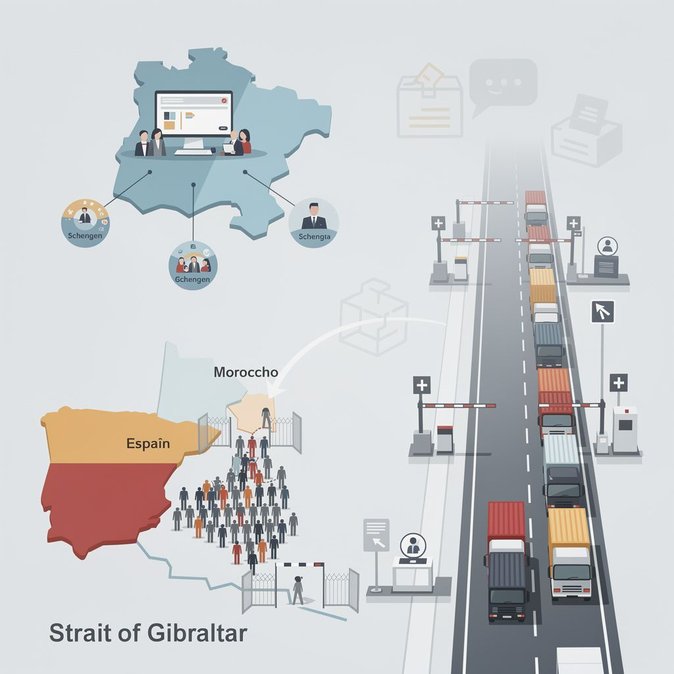
Switzerland’s Federal Councillor Elisabeth Baume-Schneider dialled in to an extraordinary videoconference of EU interior ministers on 4 August 2026 that was convened after Morocco-Spain border guards were overwhelmed on 30 July and an estimated 50,000 people entered the Spanish enclave of Ceuta. Although Switzerland is not an EU member, it is an associated Schengen state and was therefore invited to the so-called ‘Schengen Mixed Committee’ session together with Norway, Iceland and Liechtenstein. According to participants, the meeting, chaired by Ireland in its role as holder of the rotating EU Council presidency, focused on how to reinforce the bloc’s external borders, improve contingency planning and accelerate the roll-out of the new Entry/Exit System (EES). Switzerland told its partners that it had already stepped-up risk profiling at the south-western airports of Zurich and Geneva and was prepared to deploy up to 40 additional migration liaison officers to Spanish ports if requested. The Federal Office for Customs & Border Security (FOCBS) said it would also begin random checks on selected rail services from France and Italy as a “temporary, proportionate measure”. In the medium term, Bern pressed the EU to speed negotiations on joint return operations and on a possible EU-Morocco readmission accord—both dossiers in which Swiss diplomats have been closely involved since 2025. Swiss officials reiterated that any reforms must preserve the principle of free movement inside Schengen. They nevertheless signalled support for a Spanish proposal to create a permanent crisis-response reserve of 3,000 Frontex officers—an idea that would require parliamentary approval in Switzerland because it implies additional Swiss contributions to the EU border agency. For Swiss companies, the immediate impact is potential disruption to business travel on routes that cross the Franco-Spanish land border and to Ceuta and Melilla. Travel managers are being advised to monitor Federal Department of Foreign Affairs (FDFA) travel advisories and to allow extra time for identity checks within the Schengen Area. International assignment teams should pay particular attention to non-EU assignees who rely on visa-free travel; any re-introduction of systematic internal border controls could trigger temporary overstays if passports are not re-stamped on exit. Analysts note that the incident is already fuelling domestic political debate ahead of Switzerland’s 27 September referendum on the so-called “Security First” initiative, which seeks tighter asylum rules and foresees the possibility of suspending the Schengen association if migration pressures become “unmanageable”. Business groups including economiesuisse warn that such a move would severely damage Switzerland’s aviation, tourism and life-sciences sectors, all of which depend on friction-free cross-border mobility.
Source: Le Monde (English edition)