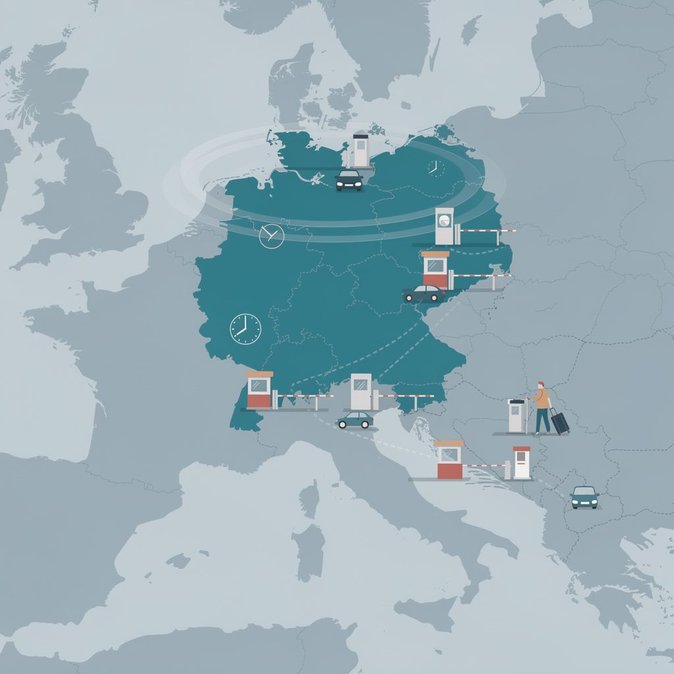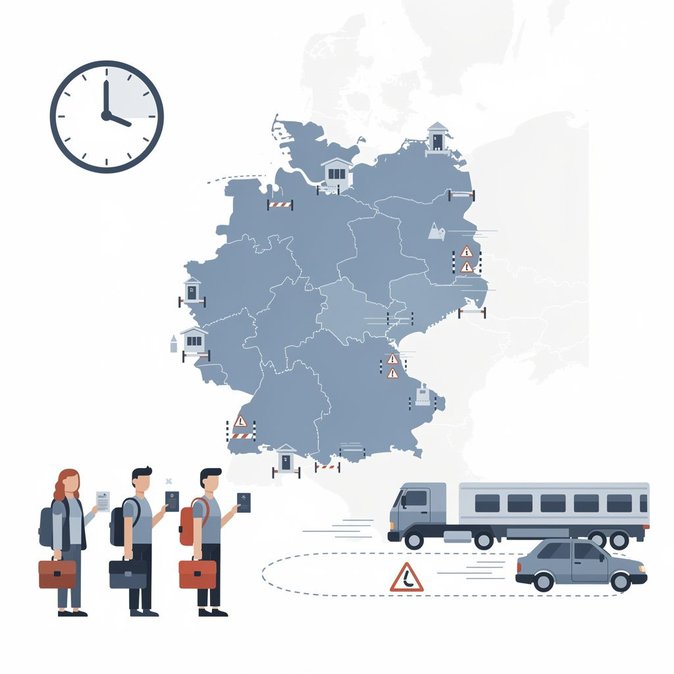
Germany will complete the re-establishment of temporary controls on all of its land borders when a new Interior Ministry order takes effect on 16 September. The tightening extends the police checks that have been in place on the eastern and southern frontiers with Poland, the Czech Republic, Austria and Switzerland since 2025. From Monday, fixed checkpoints and mobile patrols will also appear on the borders with France, Luxembourg, Belgium, the Netherlands and Denmark. According to an operational directive obtained by mobility-information portal Nodia, Bundespolizei units finished redeploying staff and equipment over the weekend. Five major autobahns (A3, A4, A6, A8, A61) will host permanent screening lanes, while officers will board cross-border ICE, TGV and Nightjet services to verify travel documents in transit. Long-distance coaches such as Flixbus must make mandatory stops at newly designated inspection areas near the frontier. The Ministry cites sustained irregular migration and smuggling as the chief reasons. Section 18 of the Asylum Act will allow officers to refuse entry to travellers without valid passports, Schengen visas or residence titles; Ukrainians holding temporary-protection residence under §24 AufenthG remain exempt from turn-backs. Nodia’s guidance urges business travellers to factor 30--90-minute delays into itineraries and to keep residence cards and proof of insurance in hand luggage. For employers, the expansion means that cross-border commuters—particularly those who live in France or the Netherlands and work in Germany—should expect document checks both on the road and on regional trains. Companies arranging meetings near the frontier are advised to add buffer time and carry invitation letters to substantiate the business purpose of travel. Although the controls are officially “temporary”, Berlin has repeatedly prolonged similar measures in the past year. A wider EU debate about the future of the passport-free Schengen area is likely to intensify once the German scheme is fully in force.
Source: Nodia