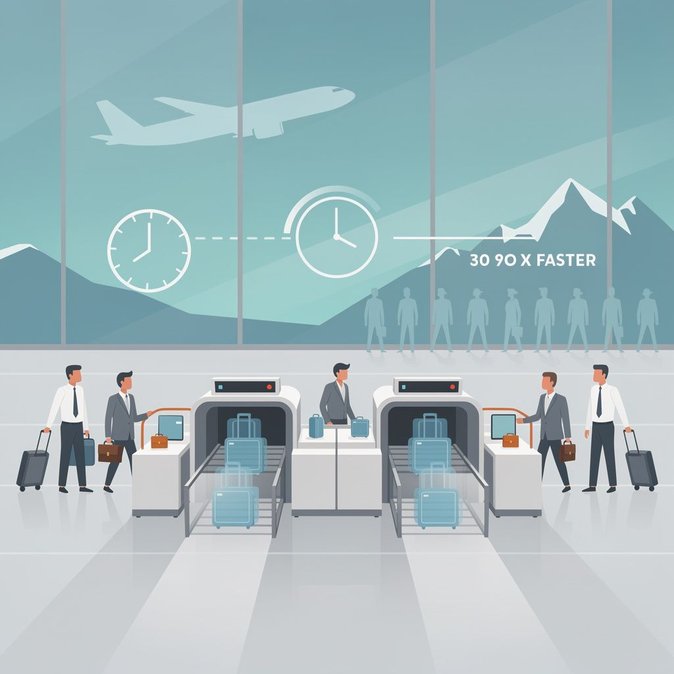
Zurich Airport says its security checkpoints are processing passengers up to 30 percent faster following the completion of a three-month project to replace all X-ray lanes with computed-tomography (CT) scanners. In a statement to Swiss public broadcaster SRF on 28 September, spokesperson Jasmin Bodmer-Breu called the rollout an “efficiency game-changer,” noting that travellers no longer need to remove laptops or liquids from hand luggage. CT technology generates three-dimensional images, allowing operators to rotate and zoom in on suspicious items without breaking the flow of trays. For business travellers the biggest benefit is predictability: Zurich’s online ‘flight-time calculator’—updated this week—now recommends shorter arrival lead-times for many morning departures. The airport does caution that some dense objects—double-walled thermos flasks or stacks of playing cards—still trigger manual bag checks. To mitigate re-screenings, Zurich Airport has published a new packing guide and is training staff to reallocate manpower in real time based on queue analytics. From a global-mobility perspective, faster security lines reduce the buffer time corporations build into itineraries, easing day-trip scheduling to Switzerland’s financial and pharmaceutical hubs. Airlines based in Terminal 1 have already adjusted minimum connection times by five minutes, according to internal slot-coordination documents seen by travel-management companies. Zurich is among the first continental European hubs to make CT scanning universal; Amsterdam Schiphol and London Heathrow are midway through similar transitions. The Swiss model—rolling out lanes overnight without closing the terminal—could serve as a blueprint for Geneva and Basel, which plan upgrades before ETIAS border formalities go live in late 2026.
Source: SRF (Swiss Radio & Television)