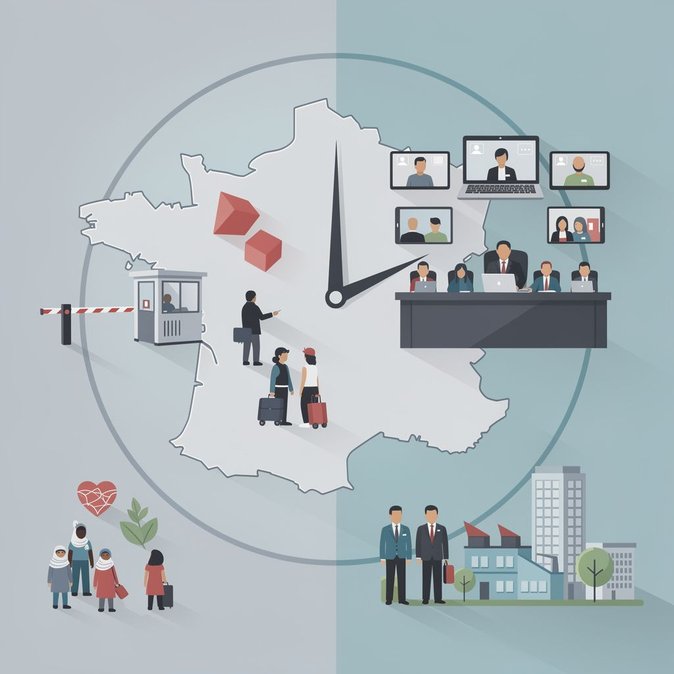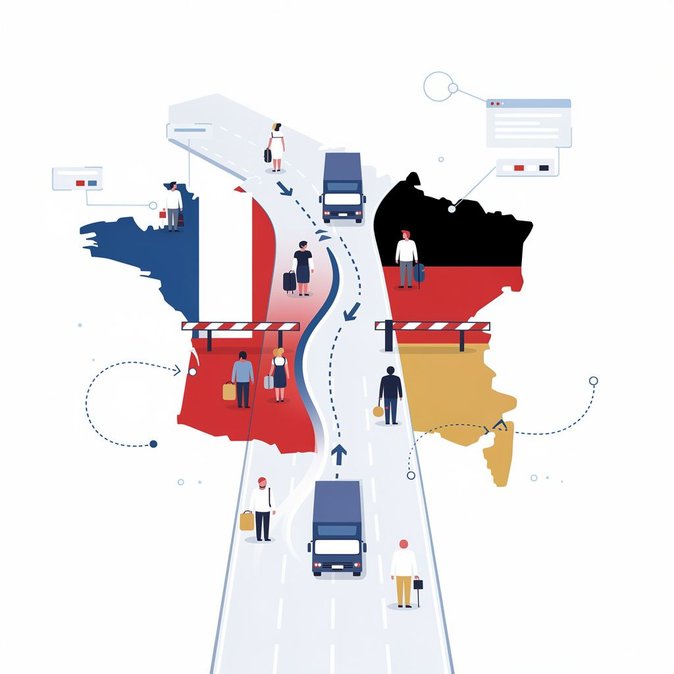
At their 26th Franco-German Ministerial Council in Paris on 17 July 2026, the French and German governments placed migration management and border security high on their joint agenda. In the communiqué released after the meeting, the two EU heavyweights said they would “ensure close coordination of our internal border controls and strengthen our common tools to enhance our cross-border cooperation in the fight against irregular immigration, in particular by gathering experience to reach an agreement under Article 23a of the Schengen Borders Code.” The language marks the strongest bilateral signal in years that Paris and Berlin intend to act in lock-step on Schengen governance. France has maintained temporary controls on its land and Channel borders since 1 May 2026, citing terrorist threats and migrant-smuggling networks. Germany likewise keeps checks on its frontiers with Poland, the Czech Republic and Austria. By promising to harmonise both the operational criteria for re-introducing controls and the data they share with Frontex and Europol, the two neighbours hope to defuse criticism from Brussels and business groups that un-coordinated checks create costly delays for road freight and cross-border commuters. For companies with mobile workforces—particularly those operating manufacturing plants in the Upper Rhine and Saar–Lorraine basins—the pledge offers a chance of more predictable processing times at the frontier. Officials indicated that pilot digital pre-clearance lanes for frequent business travellers could be tested as early as September. The joint statement also references the EU Action Plan for the Channel Route, hinting that lessons from Franco-German coordination may feed into wider Schengen reform talks this autumn. Background: Since the 2015 migration crisis, Paris and Berlin have regularly renewed internal checks under Article 25 of the Schengen Borders Code, but procedures and scope have diverged. Business lobbies on both sides complain of duplicate controls and opaque criteria. The new roadmap instructs interior ministries to draft common risk-assessment templates, share watch-list hits in near real time, and review the proportionality of controls every two months. Practical advice: Companies moving staff or goods across the Franco-German border should monitor forthcoming pilot schemes and register eligible employees once the digital pre-clearance portal opens. Mobility managers should also brief travelling staff that identity checks will remain in place through at least 31 October 2026, but that harmonised procedures should gradually reduce waiting times.