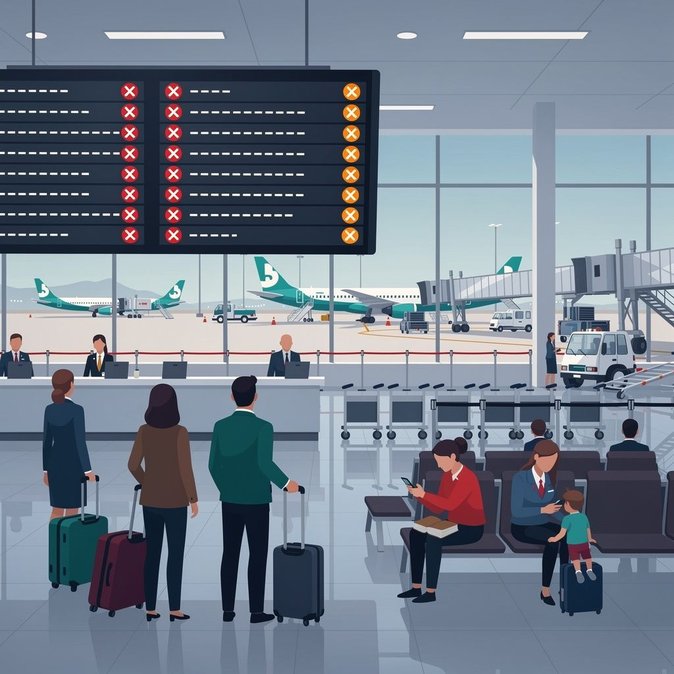
Canada’s second-largest carrier is facing its most disruptive labour dispute in a decade after 4,400 WestJet flight attendants began a nationwide strike at 03:00 ET on Sunday, 2 August 2026. The walk-out, announced by the Canadian Union of Public Employees (CUPE) only minutes after a strike deadline expired, triggered the immediate cancellation of more than 300 Boeing 737 and 787 departures and forced tens of thousands of travellers to scramble for alternatives at the height of the summer season. What is at stake The core issue is pay for the substantial pre-flight and post-flight duties that cabin crew perform on the ground—including aircraft safety checks, boarding, de-planing and customer assistance—which the union says are largely unpaid. WestJet pays attendants using a credit-hour formula tied to airborne time; CUPE is seeking an hourly wage that starts when crew report for duty and stops when they finish final cabin checks. Management’s last offer, rejected by 92 percent of voting members, included a double-digit first-year wage bump but kept the credit-hour system in place. Operational impact and business implications • Service map: All main-line WestJet flights were grounded, affecting the network from St. John’s to Victoria. WestJet Encore turboprop and codeshare flights on partners such as Delta and KLM continue to operate, but represent only 18 percent of the airline’s normal Sunday capacity. • Re-accommodation costs: Under Canada’s Air Passenger Protection Regulations, WestJet must rebook customers—at its own expense—on the next available flight “on any carrier.” During the 2023 Air Canada strike the carrier spent an estimated C$38 million on interline re-bookings; analysts expect WestJet’s bill to be higher because the stoppage coincides with the three-day Civic Holiday weekend. • Cargo and corporate travel: Calgary-based energy and agri-food exporters that rely on WestJet’s nightly wide-body belly-cargo routes to Europe report shipment delays of up to 72 hours. Corporate-travel managers are advising employees to shift to Air Canada or U.S. connectors and to budget an extra day for repositioning. Government response and next steps Federal Labour Minister Patty Hajdu urged both parties back to the table but has, so far, stopped short of ordering binding arbitration. Ottawa’s posture is being watched closely by other airline work groups—most notably Air Canada’s pilot union, which enters wage talks this autumn. Should the strike persist beyond 72 hours, the government faces pressure to invoke Section 87.4 of the Canada Labour Code to designate the dispute an “immediate and serious danger to the safety or health of the public,” a legal pre-condition for back-to-work legislation. Practical advice for mobility managers 1. Advise travellers to check flight status frequently and allow extra connection time if routed through smaller regional airports with limited ground transport. 2. Encourage the use of virtual meeting options wherever feasible this week; hotel availability in hub cities (Calgary, Toronto, Vancouver) is already tightening. 3. For employees on assignment whose work permits or visitor records expire soon, document any travel-date changes caused by the strike in case status extensions are required. The dispute highlights the vulnerability of Canadian business travel to single-carrier shocks—an issue global-mobility teams should factor into contingency planning, given the duopolistic nature of the domestic market.
Source: Associated Press