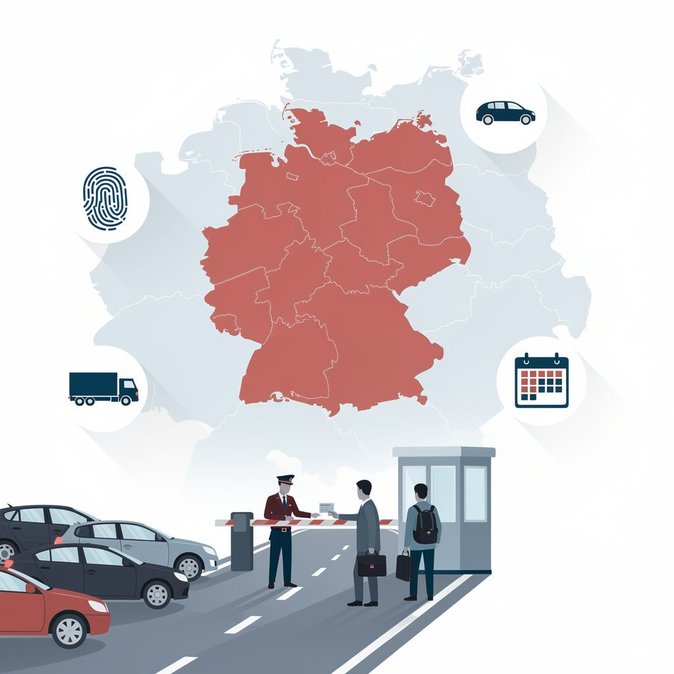
Germany’s new phase of internal border controls entered into force at 00:00 on 16 September 2026, extending stationary checks to all nine land borders for at least six months. According to the Federal Police, mobile checkpoints were deployed on key arterial motorways such as the A3 at Suben/Passau (Austria) and the A4 at Ludwigsdorf/Görlitz (Poland). Morning rush-hour tailbacks reached eight kilometres and stretched commuter travel times by up to 70 minutes. Rail operators ICE and Thalys reported average delays of 10–15 minutes as officers boarded cross-border trains at Aachen and Saarbrücken. Interior Minister Nancy Faeser argues the measure is necessary to curb irregular migration and to disrupt smuggling networks, pointing to 60,000 prevented illegal entries and 1,700 suspected smugglers detained since 2024. Yet Brussels and neighbouring capitals remain unconvinced. Poland’s Prime Minister Donald Tusk called the move a “de facto suspension of Schengen”, demanding emergency EU consultations, while Austria’s Interior Minister Gerhard Karner refused to accept readmissions of migrants turned away at the German frontier. The European Commission’s Schengen register confirms that Germany’s latest notification extends controls until 15 March 2027 – taking the country close to the three-year maximum allowed under the revised Schengen Borders Code. Critics warn that repeated six-month renewals risk normalising an instrument meant to be exceptional. Logistics associations also fear hidden costs for “just-in-time” supply chains, citing anecdotal reports of delays for lorry drivers on the A40 corridor with the Netherlands. For business travellers and cross-border commuters, the practical advice is clear: build in extra buffer time, keep passports or ID cards within easy reach and be prepared for random vehicle or baggage inspections within 30 km of the frontier. Holders of §24-residence permits (e.g., displaced Ukrainians) remain entitled to enter Germany provided they carry a valid biometric passport and their electronic residence card or a §81(4) “Fiktionsbescheinigung”.