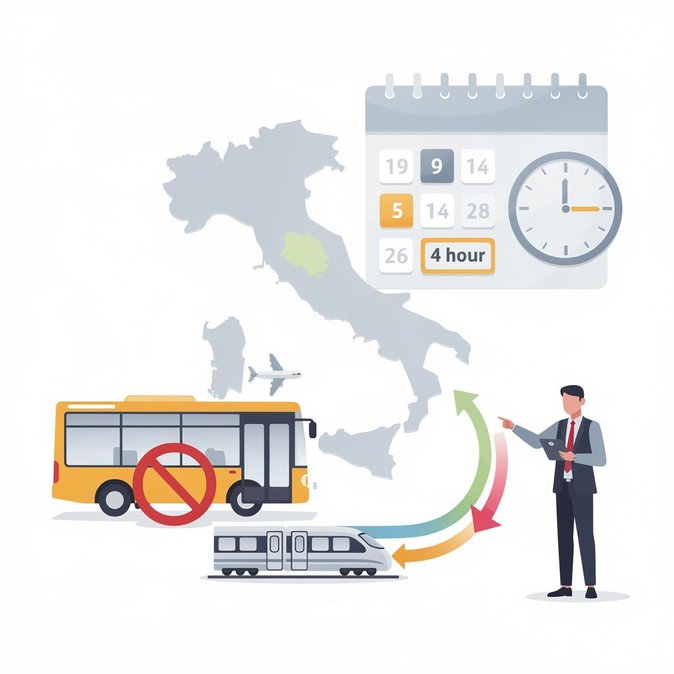
Business travellers arriving in or departing from Italy faced an exceptionally difficult Friday as ground-handling staff belonging to the grassroots unions CUB and USB mounted a 24-hour national strike. The walk-out, called to demand a long-delayed renewal of the handling contract that expired six years ago, paralysed key hubs including Milan-Malpensa, Venice-Marco Polo, Florence-Peretola and Pisa-Galileo Galilei. Cancellations and rolling delays quickly snow-balled because most airlines had reduced operations in anticipation of the action, while the knock-on effect on aircraft rotation disrupted afternoon and evening schedules. At Malpensa alone 60 departures were scrubbed and a further 20 at Linate; Venice reported 65 cancellations and Firenze about half of its total programme. National carrier ITA Airways grounded 30 domestic services and activated an extraordinary re-booking plan that managed to reaccommodate roughly half of the affected passengers on same-day flights. ENAC reminded operators that “guaranteed time-bands” (07:00-10:00 and 18:00-21:00) remained protected under Italian strike law, but the sheer concentration of traffic in those windows meant significant crowding at security and check-in. The protest centres on wages that the unions say have lost €400 per month in purchasing power over a decade. Negotiations with employers failed after management offered an average pay rise of €250 spread over three years coupled with longer working hours. Unions also object to diverting part of the increase into private welfare funds. Despite the disruption, adherence was reported as particularly strong in northern airports where the unions enjoy a greater foothold. For corporate mobility managers the strike underscores the fragility of the Italian aviation labour landscape and the importance of contingency planning. Companies with critical itineraries should continue to monitor the strike calendar published by the Transport Ministry and consider rail alternatives on trunk routes such as Milan–Rome, where high-speed services remained unaffected. Travellers should also ensure that airline contact details are up to date and download carrier apps to receive real-time re-booking options. With the busy autumn conference season only just beginning, further industrial action in the handling, air-traffic-control and public-transport sectors could have cascading effects on inbound business events. Mobility planners are therefore advised to build greater schedule buffer into itineraries for the remainder of September and early October.
Source: La Sicilia