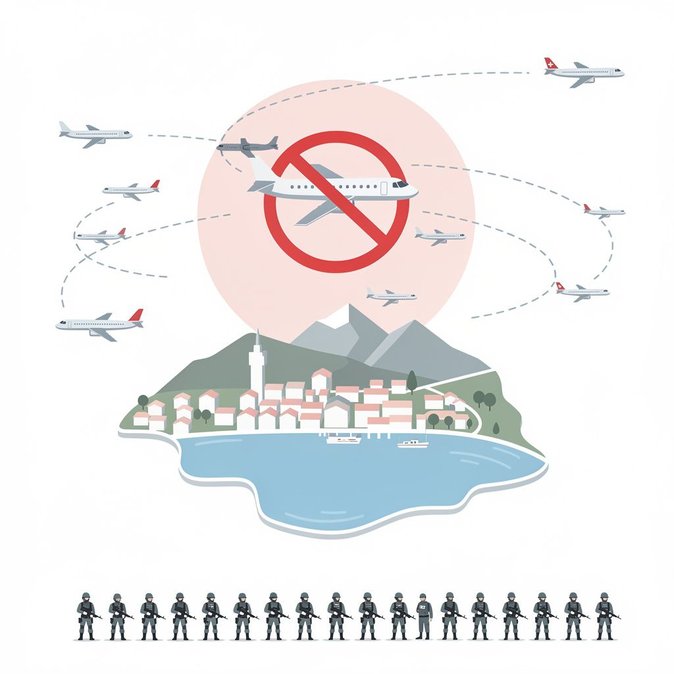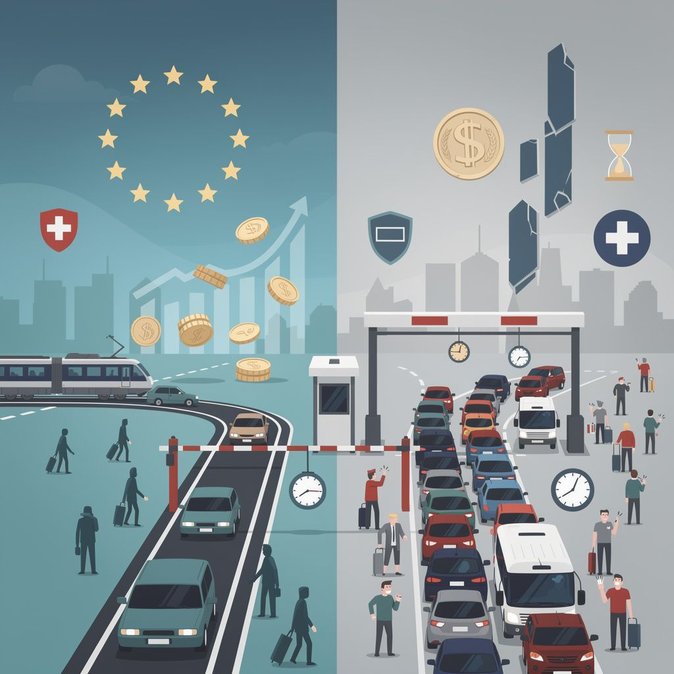
Also on 18 September the Federal Council released a 120-page report that quantifies – in stark detail – what Switzerland stands to lose if it were ever forced out of the Schengen/Dublin area. Commissioned by Parliament (Postulate 24.3946), the study projects that by 2035 Swiss GDP would be up to 3.9 % lower, with every resident CHF 1,300 poorer per year, if the country abandoned the European passport-free zone. The modelling highlights three pain points for global-mobility stakeholders. First, border congestion: without Schengen, neighbouring EU states would have to treat Swiss crossings as an external border, triggering an extra 422,000 worker-hours lost daily in traffic jams. Second, labour supply: stringent checks could deter up to 60 % of the 330,000 cross-border commuters who power Swiss hospitals, hotels and advanced-manufacturing lines. Third, tourism and business travel: non-EU visitors would once again need a stand-alone Swiss visa, depressing arrivals by an estimated CHF 320-810 million in 2035. The report emphasises security aspects, noting that Swiss police accessed Schengen Information System (SIS) databases 40,000 times in 2025; rebuilding equivalent capabilities at national level would be cost-prohibitive. For asylum processing, loss of the Dublin transfer mechanism would force Switzerland to examine claims already filed elsewhere, adding CHF 166-824 million in annual costs. Multinationals with large commuter workforces, especially in the Basel pharmaceutical corridor and Geneva’s international-organisations hub, should treat the findings as a warning shot. Relocation programmes may need contingency planning for visa-sponsorship, while HR should brace for retention issues if commute times spike. Travel managers, meanwhile, would have to budget for new visa-procurement steps and longer lead times on incoming talent. Although the report is advisory, it will weigh heavily on the ongoing political debate around the SVP’s border-control initiative and future EU negotiations. Firms with a Swiss footprint should consider communicating the economic stakes to industry associations and chambers of commerce.