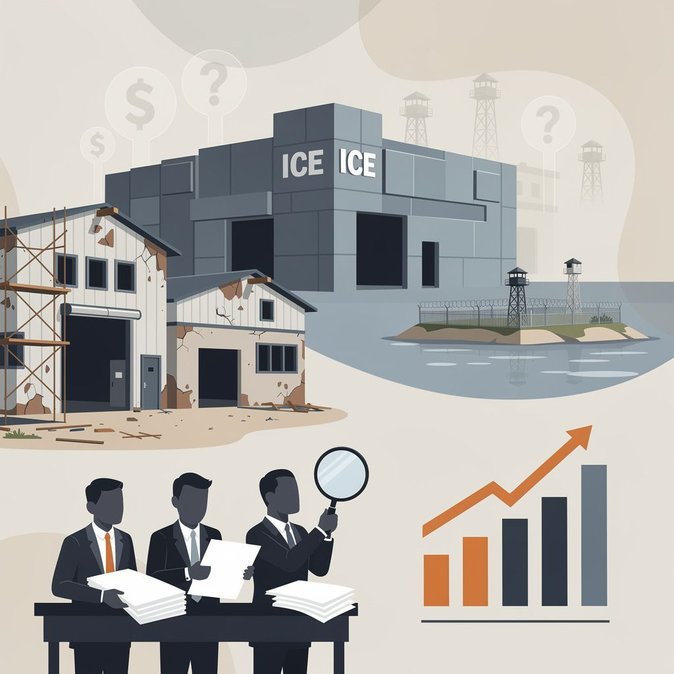
A newly released Government Accountability Office (GAO) report, unveiled on September 24 by Senators Dick Durbin (D-IL), Jack Reed (D-RI) and Gary Peters (D-MI), paints a damning picture of the Trump Administration’s hurried drive to expand immigration detention capacity. According to the lawmakers, investigators found that U.S. Immigration and Customs Enforcement (ICE) spent billions of dollars on warehouse purchases, tent cities and even a short-lived plan to use Guantánamo Bay—often without basic due-diligence or a realistic assessment of operating costs. GAO staff who visited proposed facilities in 2025 and 2026 discovered that local ICE field offices were frequently unaware the sites were slated to open within weeks. In several instances, ICE bought or leased property that ultimately proved unusable, saddling taxpayers with “non-recoverable” costs such as security, utilities and insurance. One Florida site nicknamed “Alligator Alcatraz” was mothballed after $600 million in Federal Emergency Management Agency (FEMA) grants had already been committed. The watchdog also found that ICE still lacks a coherent plan for how many detention beds it actually needs, or where they should be located by gender, risk category or medical profile. While DHS publicly cited an 80,000-bed target in 2025, officials privately told auditors their goal had climbed to 100,000 beds by mid-2026—figures not reflected in any official planning documents. For global-mobility managers, the report underscores just how fluid U.S. enforcement policy remains. Poorly planned capacity swings can trigger sudden transfers between facilities, heighten litigation risk and complicate access for attorneys and consular staff. Companies that rely on short-term visas or cross-border rotations should audit their contingency plans for employee detention or removal proceedings, particularly in jurisdictions served by the newest ICE contracts. The report’s release is likely to fuel fresh legislative attempts to cap detention spending and impose stricter performance metrics on the private-prison contractors that dominate the sector. Mobility stakeholders should watch for possible amendments in the forthcoming FY-2027 appropriations cycle that could affect detention funding, alternatives-to-detention pilots and processing timelines for humanitarian parole.