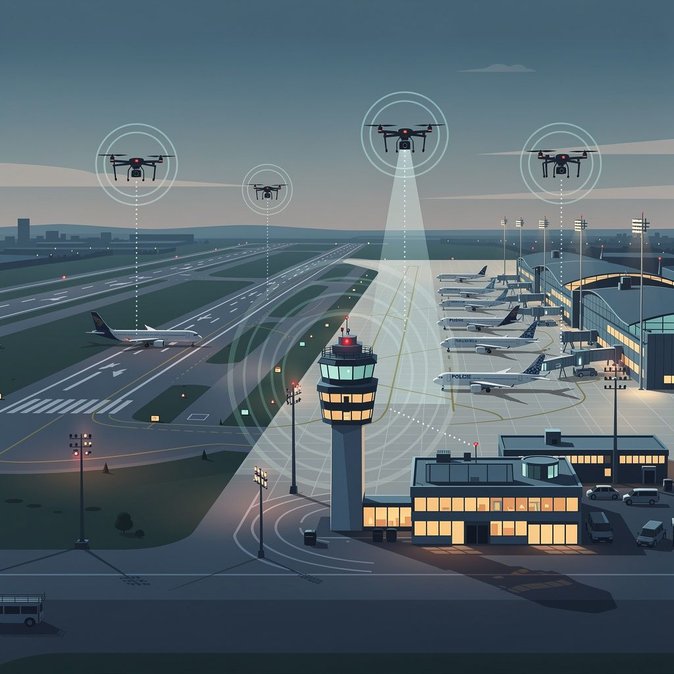
The Federal Ministry for Digital and Transport (BMDV) and air-navigation service provider Deutsche Flugsicherung (DFS) switched on a permanent drone-detection network at Berlin Brandenburg Airport (BER) on 30 September 2026. The system, developed with Israeli radar specialist RADA and German sensor firm Hensoldt, monitors a 15-kilometre perimeter and feeds real-time data to airport security, police units and air-traffic controllers. Speaking at the inauguration, Transport State Secretary Steffen Bilger called the installation “a milestone for the protection of critical aviation infrastructure”. The move follows a string of drone incursions that shut down operations at Frankfurt, Hamburg and, most recently, BER in July, costing airlines an estimated €4 million in diversion and delay expenses. Under the new arrangement DFS is responsible for the technical detection layer, while the Federal Police decide on counter-measures that range from radio-frequency jamming to targeted drone take-downs by a special intervention squad. The system is fully integrated with EUROCONTROL’s Network Manager, allowing alerts to propagate across European air-navigation centres within seconds. Airlines will also see revised NOTAM procedures: when an unidentified drone is detected, ground stops will be localised to affected runways rather than the entire airport, potentially cutting disruption time by up to 60 %. For business-travel managers the practical advice is to keep contact details in bookings up to date so that automated re-accommodation messages reach travellers quickly if a drone incident still triggers delays. Corporate security teams should also note that Germany plans to roll out similar detection grids at Frankfurt (FRA) and Munich (MUC) before the 2026/27 winter schedule begins. Industry analysts view Germany’s approach as a template for EU-wide standards that will likely become mandatory once the long-awaited EASA Counter-UAS Regulation is adopted in 2027. Manufacturers of legitimate commercial drones welcomed the clarity, arguing that professional operators benefit when rogue devices are rapidly identified and neutralised.