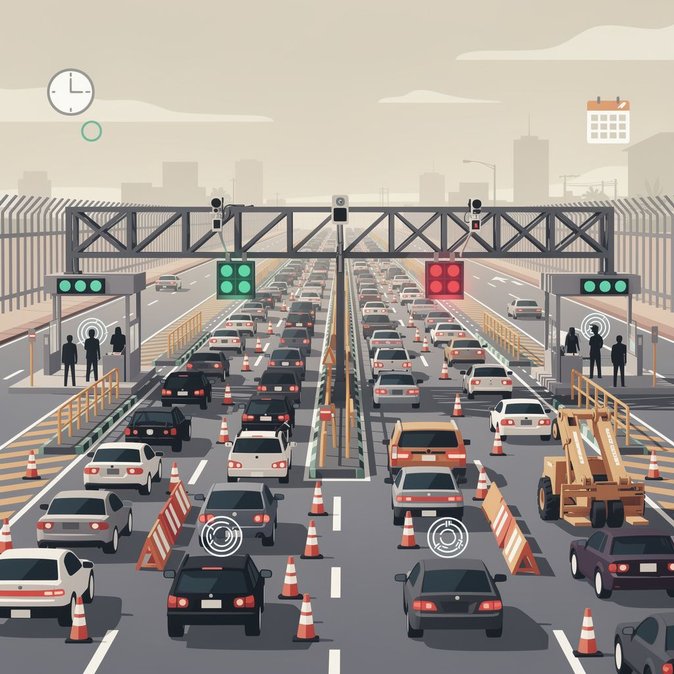
Business commuters on the San Diego–Tijuana corridor endured severe delays on 30 September 2026 as U.S. Customs and Border Protection (CBP) reduced auto lanes at the San Ysidro and Otay Mesa ports of entry to install new facial-recognition cameras. CBP’s public feed showed standard-vehicle waits peaking at 160 minutes at San Ysidro (6 of 34 lanes open) and 90 minutes at Otay Mesa (4 of 13 lanes open) during the mid-afternoon rush. The closures mark the first hardware deployment under CBP’s next-generation Simplified Arrival land-border programme, which extends biometric exit/entry verification beyond airports. Unlike earlier pilots limited to SENTRI expedited-traveller lanes, the new equipment captures all vehicle occupants in standard and Ready Lanes, allowing officers to cross-check identities without collecting fingerprints. CBP officials say lane counts will return to normal by 6 October, but only after each booth’s camera array and secure fibre connection passes acceptance testing. For cross-border manufacturing executives, the timing is painful: month-end logistics runs coincide with Mexico’s Día de la Raza holiday week, historically one of the heaviest personal-travel periods. Regional chambers of commerce estimate that every extra 15 minutes at San Ysidro costs the binational economy roughly US $1.3 million in lost productivity and retail sales. CBP is advising frequent travellers to enrol in SENTRI, which on 30 September maintained 10-minute waits even as general lanes crawled, and to download the CBP Border Wait Times app for push alerts. Companies moving time-sensitive goods should consider re-routing through Tecate or the Cross-Border Xpress cargo corridor, both of which saw sub-60-minute delays. The episode offers a preview of 2027, when CBP is scheduled to retrofit every southern land port with facial biometrics under a DHS interim final rule currently before the Office of Management and Budget. Until the technology consistently matches enrolment speeds, travellers can expect rolling lane closures and uneven throughput at U.S.–Mexico gateways.
Source: WaitTimeReport.com (CBP Feed)