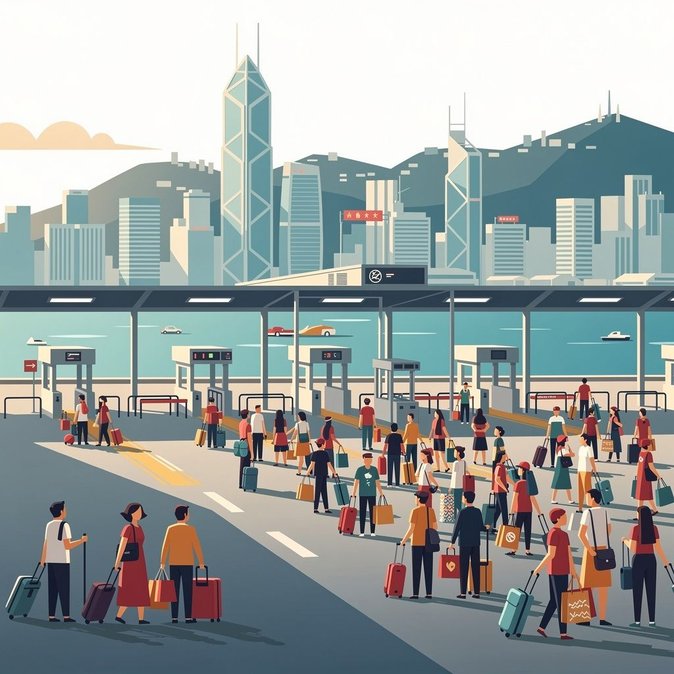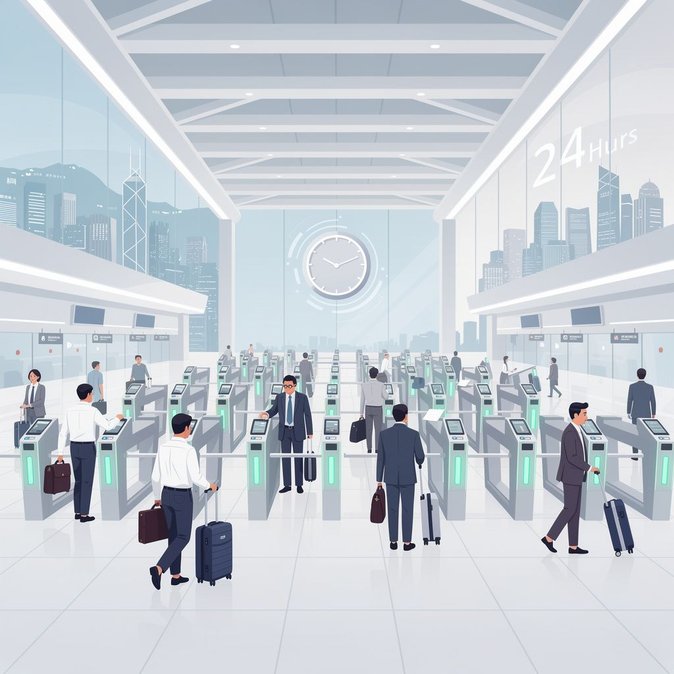
Authorities on both sides of the Shenzhen-Hong Kong boundary gave 1,500 Hong Kong residents an exclusive preview of the rebuilt Huanggang Port on October 4. Visitors were bussed to the checkpoint to experience its 134 automated e-channels and a “co-located joint-inspection” hall that will let travellers complete immigration and customs checks in a single stop. Huanggang is one of the busiest land crossings between the mainland and Hong Kong. Under the ‘East in, West out’ redevelopment plan, it has been rebuilt into a 24-hour passenger-cargo hub able to process 200,000 people a day. Trials in August stress-tested emergency evacuation, biometric systems and vehicle lanes, paving the way for a formal opening that media say could be as early as 12 October. For multinational firms that rotate staff between the two cities, the biggest benefit is time. A single-stop clearance model is expected to cut average processing to under five minutes, while the large bank of e-channels should absorb peak-hour shuttle-bus waves during trade fairs and the Canton Fair season. Logistics operators also expect faster cross-border trucking once freight bays open next year. The port forms part of the Greater Bay Area’s push to knit Hong Kong, Shenzhen, Dongguan and Guangzhou into a one-hour living circle. Companies that station regional staff in Shenzhen but rely on Hong Kong for banking or client meetings will gain a round-the-clock land alternative to air or high-speed rail. Travel-policy managers should update staff handbooks to reflect the new routing and confirm that all employees’ electronic mainland travel permits are registered for e-channel use. Once operational, Huanggang will be the fourth Shenzhen checkpoint with co-located clearance after West Kowloon (high-speed rail), Liantang/Heung Yuen Wai and the Hong Kong-Zhuhai-Macao Bridge port, underscoring a broader regional trend towards friction-free borders driven by biometrics and big-data risk profiling.
Source: South China Morning Post