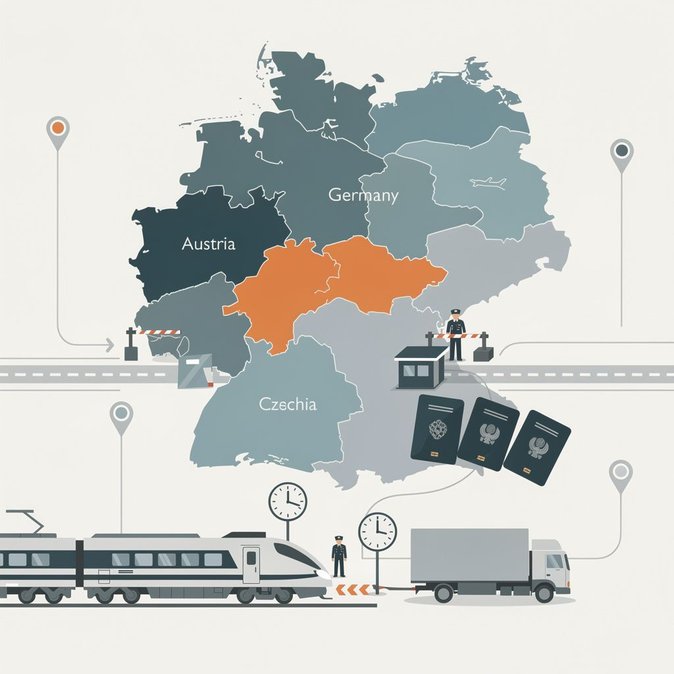
Czech business travellers heading west will continue to face systematic checks at the land borders with Austria and Germany for at least another five months. An updated register published by the European Commission’s Directorate-General for Migration & Home Affairs on 11 October 2026 confirms that both Vienna and Berlin have notified a fresh six-month extension of their temporary re-introduction of controls at internal Schengen borders, citing continued high levels of irregular migration, pressure on asylum systems and wider security concerns linked to Russia’s war against Ukraine and instability in the Middle East. For Czech companies that rely on same-day road movements of staff or just-in-time deliveries to Bavarian and Upper-Austrian plants, the decision means that spot checks, document inspections and occasional traffic queues at the main crossings (D 5/D E50 Rozvadov–Waidhaus, D 3 Dolní Dvořiště–Wullowitz and D 52 Mikulov–Drasenhofen) will remain a fact of life through the winter peak. Trade associations report average waiting times of 15–30 minutes during the morning rush, but random intensive operations can extend delays to over an hour. Travellers are advised to carry passports, residence permits and proof of accommodation or onward travel, even though those documents are not normally required for intra-Schengen journeys. The measures are authorised under Articles 25a and 27 of the Schengen Borders Code, which allow member states to re-introduce internal border control in the event of a serious threat to public order or internal security for renewable six-month periods. The latest notifications run from 16 September 2026 to 15 March 2027 and specifically cover Austria’s land borders with Czechia, Slovakia, Hungary and Slovenia, and Germany’s land borders with Czechia, Poland, Switzerland, France, Luxembourg, Belgium, the Netherlands, Denmark and Austria. Although the Commission has repeatedly criticised the ‘quasi-permanent’ nature of some internal controls, it accepted the necessity of the current extensions in a June 2026 opinion. Negotiations on a re-write of the Schengen Borders Code that would strengthen the focus on police co-operation and technological solutions such as the Entry/Exit System (EES) are still underway. Until a compromise is reached, mobility managers should budget extra buffer time for road and rail connections, brief mobile workers on their rights during spot checks, and monitor real-time traffic feeds to avoid bottlenecks. For aviation, the controls do not affect direct flights from Prague to Vienna, Munich or Frankfurt, but travellers connecting onwards by rail or car should allow additional time. Rail operators report only minor timetable disruptions so far, but an increase in on-board identity checks by federal police has been noted.