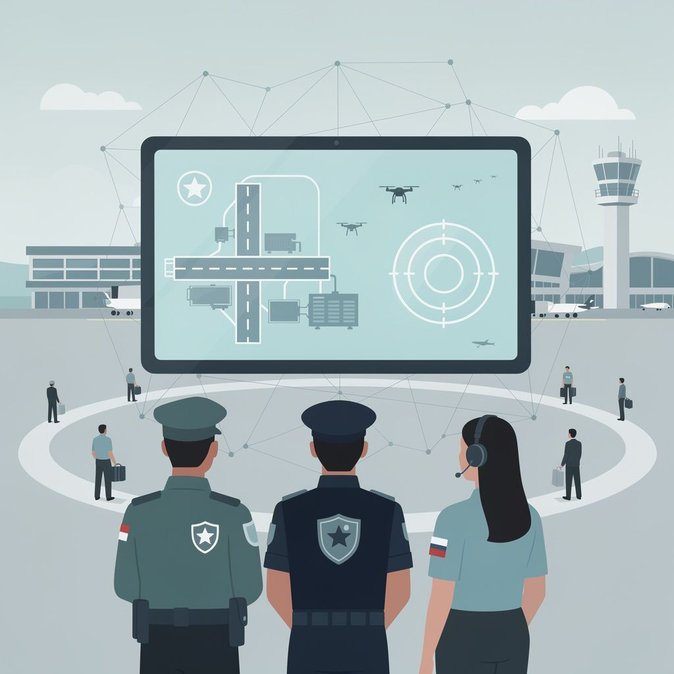
Speaking to transport daily Zdopravy.cz on 11 October 2026, former Prague Airport chief executive Václav Řehoř argued that Czech airports must overhaul their security model to confront drones, cyber-attacks and sabotage. "The airport cannot protect itself alone; the police, intelligence services and—crucially—the army have to be fully integrated into contingency planning," he said, citing the recent discovery of an armed drone inside Leipzig Airport as a wake-up call. Řehoř, who led the airport from 2014-2021 and now heads defence-technology firm URC Systems, outlined a three-pillar strategy: (1) a joint command centre that fuses perimeter sensors, drone-detection radars and cyber-feeds; (2) legally-defined rapid-response protocols clarifying when police or military units assume control; and (3) a "security culture" among thousands of airport employees and contractors to identify anomalies early. He noted that Czech legislation already allows police to neutralise hostile drones but called for clearer rules in the grey zone between criminal acts and state-level threats. For corporate mobility planners the interview sheds light on evolving risk profiles at one of Central Europe’s busiest transfer hubs. Increased military presence could translate into randomised patrols, temporary checkpoints or air-space closures during exercises—potentially affecting flight schedules and passenger flows. On the positive side, integrated counter-drone systems and joint drills should shorten disruption time after incidents such as runway incursions or GPS jamming. Travel risk managers should update crisis-management plans to include hybrid-threat scenarios and monitor NOTAMs for short-notice security restrictions. Řehoř also advocated embedding reservists who work at the airport into armed-forces structures, mirroring Finland’s "total defence" concept. If implemented, Prague could become a test case for EU discussions on sharing military capabilities to protect critical transport infrastructure. The Czech Ministry of Transport is expected to present a draft "Airport Resilience Plan" to parliament by year-end, incorporating many of the recommendations—suggesting regulatory changes and investment decisions are imminent.
Source: Zdopravy.cz