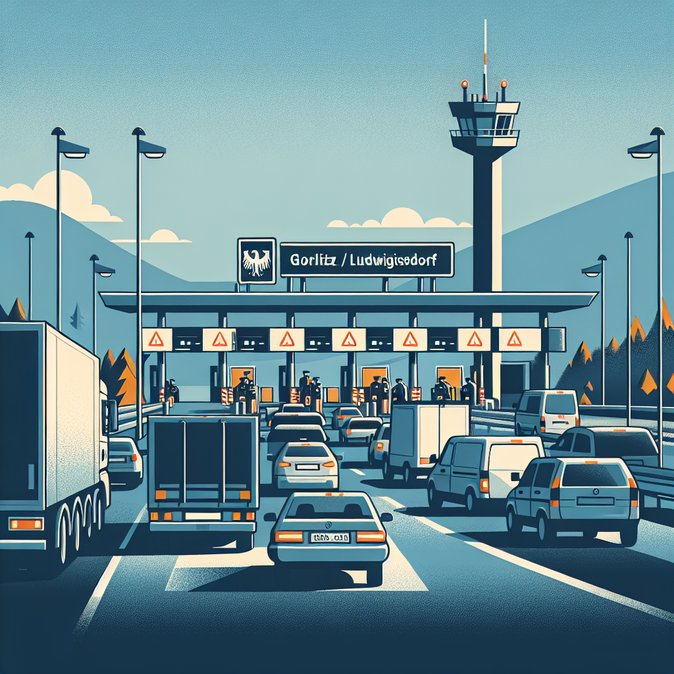
Hauliers moving goods between Germany and Poland faced fresh headaches on 25 January after Saxon police intensified spot checks at the A4 crossing near Ludwigsdorf/Görlitz. According to local incident reports, officers are now examining driver licences, tachograph records, weight limits and cargo documentation on almost every truck, turning back non-compliant vehicles and issuing on-the-spot fines.
The clamp-down follows Berlin’s decision earlier this month to prolong ‘temporary’ internal-Schengen controls until at least 15 March 2026. While aimed at curbing people-smuggling, the controls inevitably spill over into commercial traffic. Logistics analysts at Meyka estimate that wait times during Thursday’s evening peak reached 45 minutes – enough to jeopardise just-in-time deliveries to VW’s plants in Zwickau and Dresden.
![Görlitz Border Checks Tighten: Freight Operators Warn of A4 Delays]()
Automotive suppliers and parcel networks are the most exposed. Missed delivery windows can trigger contractual penalties or force expensive air-freight substitutions. Mobility managers are therefore advising drivers to carry impeccably organised CMR documents and to consider alternative corridors via the A12 Frankfurt (Oder) or A15 Forst crossings.
German-Polish trade exceeds €150 billion a year; the A4 corridor alone handles roughly 6,000 trucks daily. Industry groups are pressing the Interior Ministry for a green-lane scheme for pre-vetted carriers, but officials say priority remains on security until migrant flows ease. In the meantime, companies are told to add buffer time, pre-validate vehicle papers and share live GPS data with warehouse teams to mitigate knock-on delays.
The clamp-down follows Berlin’s decision earlier this month to prolong ‘temporary’ internal-Schengen controls until at least 15 March 2026. While aimed at curbing people-smuggling, the controls inevitably spill over into commercial traffic. Logistics analysts at Meyka estimate that wait times during Thursday’s evening peak reached 45 minutes – enough to jeopardise just-in-time deliveries to VW’s plants in Zwickau and Dresden.

Automotive suppliers and parcel networks are the most exposed. Missed delivery windows can trigger contractual penalties or force expensive air-freight substitutions. Mobility managers are therefore advising drivers to carry impeccably organised CMR documents and to consider alternative corridors via the A12 Frankfurt (Oder) or A15 Forst crossings.
German-Polish trade exceeds €150 billion a year; the A4 corridor alone handles roughly 6,000 trucks daily. Industry groups are pressing the Interior Ministry for a green-lane scheme for pre-vetted carriers, but officials say priority remains on security until migrant flows ease. In the meantime, companies are told to add buffer time, pre-validate vehicle papers and share live GPS data with warehouse teams to mitigate knock-on delays.
Source: Meyka Law & Government Blog