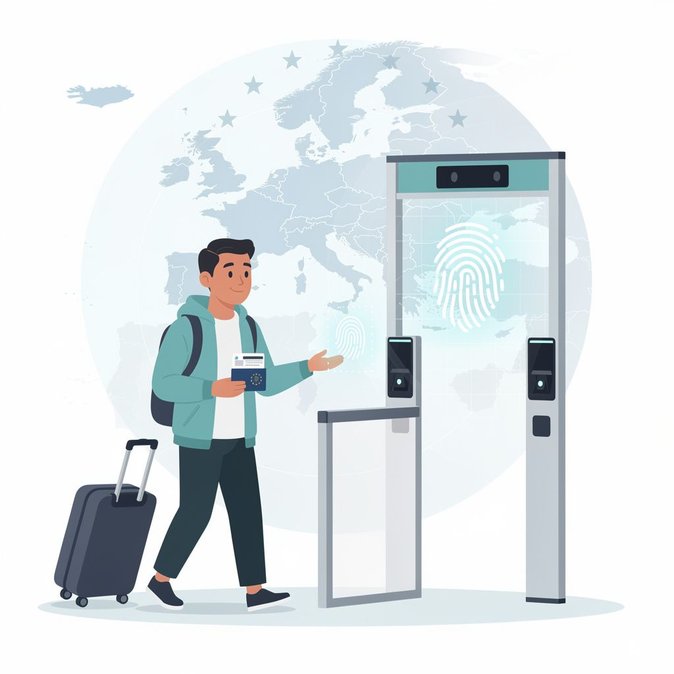
The European Commission’s Directorate-General for Migration and Home Affairs has issued fresh guidance on how the new Entry/Exit System (EES) applies now that it has been fully operational for more than three months. In a notice published on 27 July 2026, Brussels reminds travellers that the EES automatically records passport data, facial images and fingerprints for all non-EU nationals entering or leaving the Schengen Area. The system has already logged more than 145 million movements since its launch on 10 April 2026. Contrary to some social-media commentary, the document makes clear that holders of long-stay visas or residence permits issued by Cyprus or Ireland are **not exempt** from biometric registration. Cyprus, still outside Schengen, chose to activate EES at its airports and seaports in line with its accession roadmap; as a result, third-country nationals resident in Cyprus face the same kiosk process when crossing an external Schengen frontier as other non-EU travellers. The only travellers spared the new procedure are diplomats, certain cross-border maritime crews, and family members of EU/EEA citizens carrying EU-issued residence cards. Business visitors who make frequent trips via Larnaca or Paphos therefore need to budget extra time—officially around 60-90 seconds per person—for the biometric capture at connecting airports such as Athens, Vienna or Frankfurt. Airlines have been advised to communicate the change during check-in so that Cypriot residence-permit holders are not caught out during tight transfers. For multinational employers managing regional assignments through Cyprus, the clarification removes doubt over compliance responsibilities. Mobility managers should update pre-departure briefings and ensure that staff holding MEU residence permits or temporary “pink slips” understand they must register fingerprints the first time they re-enter Schengen after 10 April. Failure to complete EES enrolment can lead to refused boarding on the return leg or a fine at the border. Companies are also reminded that from mid-2027, EES data will interface with ETIAS, meaning any over-stay detected by the system could automatically block future travel authorisations. Looking ahead, the guidance signals the Commission’s determination to keep the EES timetable on track despite calls from some member states to pause the rollout during the busy summer season. For Cyprus—which hopes to secure a positive political decision on Schengen accession later this year—the smooth functioning of the kiosks at Larnaca and Paphos will be an important test case when EU ministers assess the island’s external-border readiness.