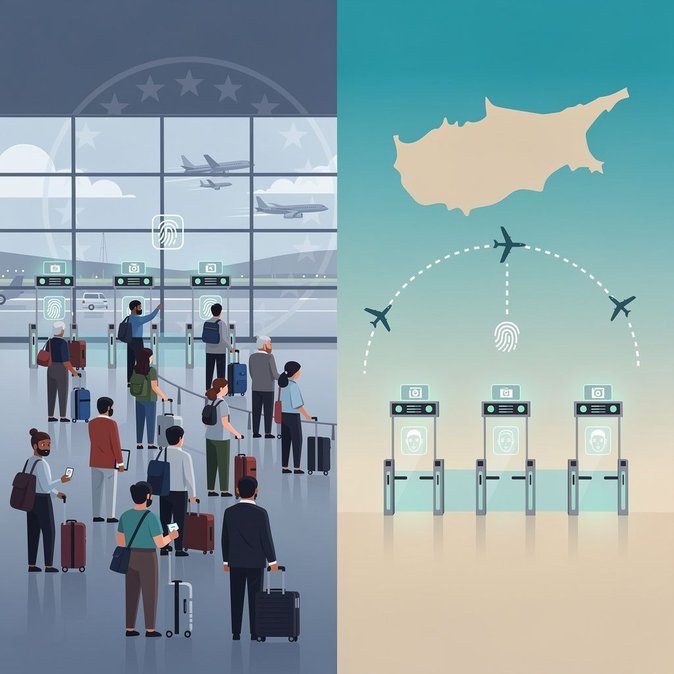
Queues lasting up to three hours were reported this week at Paris-Charles de Gaulle, Frankfurt, Amsterdam-Schiphol and other major hubs as the European Union’s new Entry/Exit System (EES) logged its first peak-season stress test. The biometric system — fully operational since 10 April 2026 for non-EU short-stay travellers — replaces passport stamps with a digital register of fingerprints, facial images and travel data. Nine member states have already asked Brussels for permission to suspend the collection of biometrics temporarily when congestion becomes unmanageable. Cyprus, which is not yet part of the Schengen Area, technically sits outside the EES — but not for long. Hermes Airports, operator of Larnaca and Paphos, confirmed on 25 September that it has ordered forty automated e-gates capable of handling the fingerprint and facial-recognition requirements once Cyprus joins Schengen, expected in 2027. Installation is scheduled for late 2026, giving border-police and ground-handling staff less than six months to learn the new procedures before a probable ‘big-bang’ switch-on. While Cypriot passengers currently avoid the worst of the bottlenecks, the indirect impact is already being felt. Airlines are adding longer connection windows for itineraries that route through EES-affected airports, and freight forwarders warn that missed crew connections could ripple into supply-chain delays during the winter shipping rush. Business travellers transiting European hubs are advised to allow at least a three-hour layover until further notice. Government sources say Nicosia is monitoring the situation closely and may seek an initial derogation to phase in biometric capture gradually if the EU grants similar flexibilities next summer. Industry groups such as the Cyprus Shipping Chamber and the Cyprus Employers & Industrialists Federation are urging the state to accelerate staff training and public-information campaigns to avoid a “day-one meltdown.” For mobility managers the takeaway is clear: Cyprus will inherit the EES learning curve just as everyone else is trying to smooth it out. Companies relocating staff or operating rotational rosters through Larnaca and Paphos should budget for possible onboarding delays, additional documentation checks and higher demand for premium-lane services once biometric borders arrive.