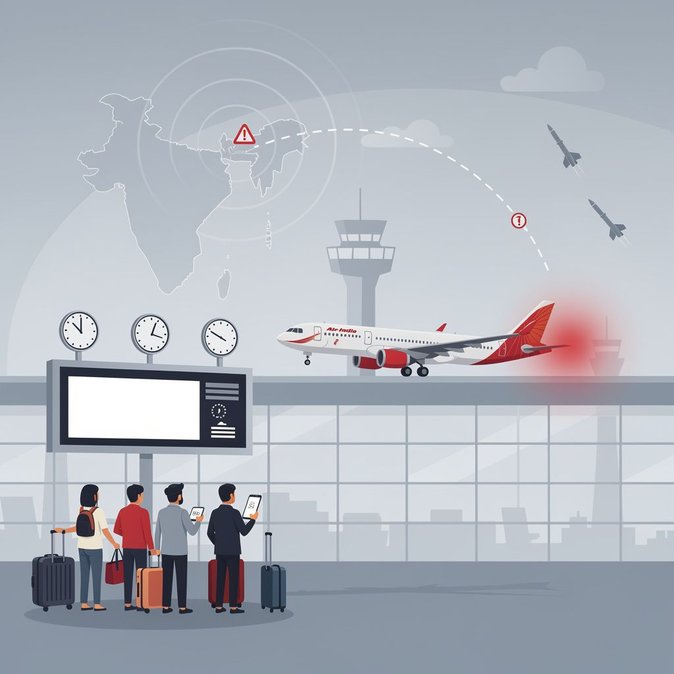
India’s busiest Gulf air corridor came to a sudden halt on 8 October 2026 after Houthi rebels in Yemen claimed a fresh ballistic-missile strike on Riyadh’s King Khalid International Airport. An Air India Boeing 787 operating the Delhi–Riyadh AI 925 rotation received air-traffic alerts minutes before Top of Descent and diverted back to Delhi with 156 passengers and crew. Within hours the Embassy of India in Riyadh and the Consulate in Jeddah issued an ‘IMPORTANT ADVISORY’, urging the 22-lakh-strong Indian community in Saudi Arabia to “remain alert, avoid non-essential travel and stay indoors if local authorities so advise.” Air India, Air India Express and IndiGo – which collectively operate 56 weekly frequencies to the Saudi capital – cancelled all departures to and from Riyadh until 10 October, triggering a scramble among labour-market intermediaries and corporate travel desks to re-book staff through Jeddah, Dammam or Doha. Lufthansa Group, Flynas and Saudia followed suit, citing war-risk insurance clauses. Travel-management companies estimate that more than 7,000 Indian contract workers and at least 600 business travellers will miss planned project mobilisations or board meetings in the Kingdom over the next three days. For Indian outbound mobility programmes the immediate tasks are duty-of-care and immigration compliance. Employers must account for stranded staff whose Saudi visit visas may expire before services resume; overstayers face SAR 10,000 penalties and future entry bans. The Indian embassy advises travellers to file force-majeure extension requests online through the Saudi Ministry of Foreign Affairs’ e-portal and to carry proof of cancelled flights. Organisations with Ajeer-registered employees have been told to update labour contracts if assignments are delayed beyond 30 days. From an aviation-security standpoint, the episode highlights the vulnerability of high-frequency short-haul business routes to geopolitical shocks. Indian carriers shifted to Iranian airspace routings after the Russia-Ukraine conflict; now they face Yemen-Saudi missile risk corridors. Aviation insurers are reassessing war-risk premiums for Gulf sectors, a cost that could flow through to corporate fares. Mobility managers should watch NOTAMs for Riyadh, Abha and Dammam and keep alternative routings via Muscat or Bahrain on standby. In the longer term, the disruption may accelerate bilateral talks on a trusted-traveller corridor that was due to launch in early 2027. Both governments had planned priority immigration lanes for pre-cleared business visitors at Riyadh and Delhi, but the security situation will likely push that timeline out. Until stability returns, companies should activate crisis-response playbooks, maintain real-time traveller tracking, and update travel-approval thresholds for Saudi Arabia.