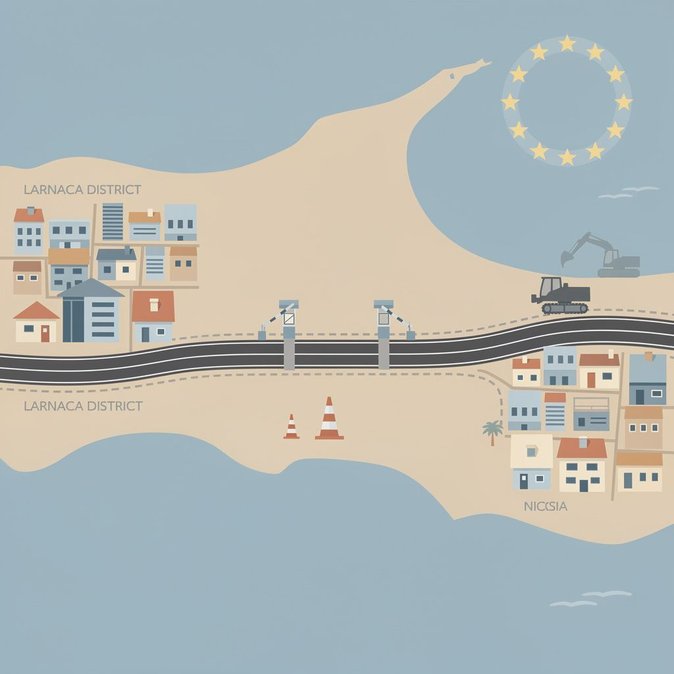
A key confidence-building measure in the long-stalled Cyprus peace talks moved a step closer this week after Greek-Cypriot negotiator Menelaos Menelaou confirmed that the routing dispute blocking a new crossing at Pyroi has been resolved. The planned road would link the government-controlled village of Athienou with Aglandjia on the outskirts of Nicosia, allowing vehicles to transit the UN-patrolled buffer zone at Pyroi for the first time. Opening the crossing would cut journey times for thousands of commuters and farmers who currently detour via the Agios Dometios or Pergamos checkpoints, and would create an alternative corridor for commercial traffic moving between Larnaca port, Nicosia and communities inside the eastern Mesaoria Plain. According to Menelaou, the remaining obstacle is the Turkish-Cypriot side’s insistence on simultaneously opening a second crossing between Louroujina and Lympia. The Greek-Cypriot side instead proposes a crossing near Kokkina, arguing that opening Louroujina could expose Athienou to security risks because the village is almost encircled by Turkish-controlled territory. Negotiators from both sides had originally agreed in March 2025, during UN-brokered talks in Geneva, to open four new crossings; however, political wrangling over locations has repeatedly delayed implementation. Why does this matter for global mobility? First, the Pyroi checkpoint would become the ninth crossing between the two sides, further normalising everyday movement for workers, students and tourists and easing reliance on the congested Agios Dometios gate. Second, better internal connectivity strengthens Cyprus’ case for eventual accession to the Schengen Area, because EU examiners have long pressed Nicosia to demonstrate effective control of all entry and exit points. Finally, each additional crossing reduces transaction costs for companies with staff who must traverse the Green Line—particularly logistics firms shuttling between Larnaca port, Nicosia warehouses and Famagusta. If agreement can be reached on the remaining sticking point, civil-engineering surveys could begin before the end of the year, with UNFICYP expected to supervise construction inside the buffer zone. Local authorities in Athienou have already earmarked funds to upgrade feeder roads, while the European Commission’s Aid Programme for the Turkish-Cypriot community has indicated it could co-finance signage and lane-marking to ensure EU road-safety standards. In the interim, businesses that rely on cross-line trade should review their transport schedules and consider how the new route could trim delivery times once operational.
Source: Cyprus Mail