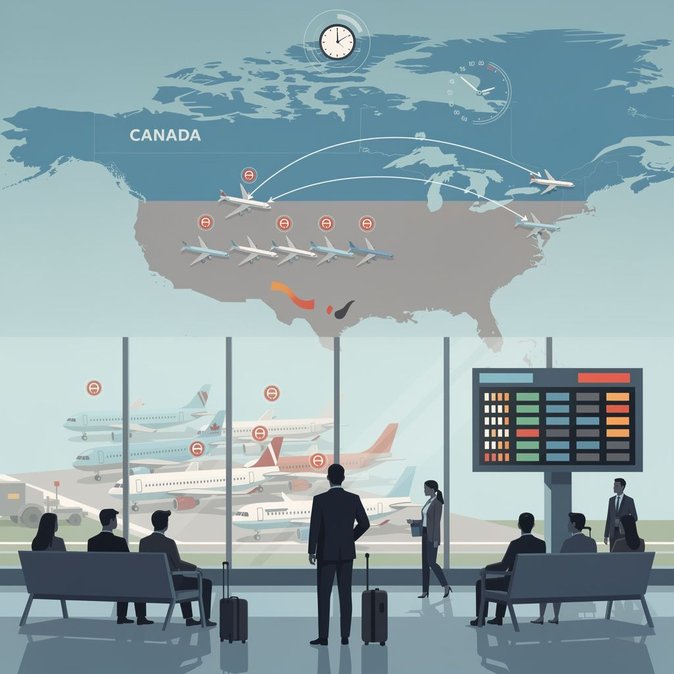
Flights between Canada and the United States were thrown into chaos late Friday, November 13, when the U.S. Federal Aviation Administration (FAA) ordered an unprecedented nationwide ground stop after a telecommunications failure crippled multiple air-traffic-control centres. Although the order was lifted just after 23:00 ET, the knock-on effects spilled well into Saturday, November 14, delaying or cancelling hundreds of cross-border departures from Toronto Pearson, Montréal-Trudeau, Vancouver, Calgary and Ottawa. NAV Canada, which manages Canadian airspace, confirmed that no Canadian systems were affected but warned that crews would need most of the weekend to “re-sequence” aircraft and reopen slots lost during the outage. For corporate travel managers the timing could hardly be worse: the mid-November spike in pre-holiday business trips normally pushes trans-border capacity close to its limits. Large multinationals operating “day-trip” shuttles between head-office campuses in Toronto and the U.S. Northeast reported widespread itinerary changes, while Canadian exporters shipping just-in-time parts to U.S. plants scrambled to rebook cargo space. Several employers invoked their travel-risk protocols, advising staff to defer non-essential travel and to use collaboration tools until schedules stabilise. Canadian regulators are monitoring the situation but have little direct leverage: under the Canada-U.S. Air Transport Agreement, safety-of-flight decisions remain the sole jurisdiction of the FAA when Canadian aircraft enter U.S. airspace. Transport Minister Steven MacKinnon said Ottawa is “in constant contact” with both the FAA and NAV Canada and will press Washington to accelerate long-planned upgrades to America’s ageing air-traffic infrastructure. The FAA, for its part, has asked Congress for an emergency US$30 billion to modernise the system. Practical implications for travellers will linger for at least 48 hours. Airlines must reposition crews and aircraft, meaning residual cancellations are likely through Sunday night. Cross-border rail and inter-city bus operators reported an uptick in last-minute bookings as travellers sought alternatives. Companies with critical employee movements should monitor flight status in real time, build extra connection buffers and remind mobile staff of duty-of-care resources. With the busy U.S. Thanksgiving period only ten days away, analysts warn that a repeat outage could have even wider economic consequences for the deeply integrated Canada-U.S. business corridor.
Source: Global News